
ATS Resume Guide: How to Create a Resume That Passes ATS
Maan C.
May 21, 2026
14 min read




Most resumes are not rejected by people. They are filtered out by software before a human ever sees them.
This does not mean your resume is weak. It often means it was not written in a way the system can read.
According to RecruitCRM's 2026 survey of recruitment professionals, 93% of recruiters use an Applicant Tracking System to streamline their hiring process. Among Fortune 500 companies, Jobscan's annual ATS Usage Report found 98.4% used a detectable ATS in 2024. If you are applying to any medium or large company, your resume is almost certainly going through an ATS before a recruiter reads it. CoverSentryJobscan
In practice, this means your resume needs to pass two checks: the system can read it, and the content matches what the job requires. If either fails, your resume may never be seen — regardless of how qualified you are.
Most resumes are filtered by software before a human ever sees them — and the fix is simpler than most people expect. An ATS-friendly resume is not about tricks or workarounds. It is about clear structure, matched keywords, and plain formatting that the system can read. This guide explains exactly how ATS works and what to do before you submit your next application.
Who This Guide Is For
- Job seekers applying to medium or large companies
- Anyone whose applications go unanswered despite relevant experience
- Recent graduates building their first professional resume
- Career switchers updating their resume for a new field
What Is an ATS Resume?
An ATS resume is a resume formatted and written so that Applicant Tracking Systems can scan, understand, and rank it correctly.
It focuses on clear structure, relevant keywords, and simple formatting. The goal is not to trick the system. It is to make your experience easy to read and match — for both the software scanning it and the recruiter who sees it next.
How ATS Actually Works
Most systems follow a consistent process:
- Scan your resume
- Extract key information — skills, experience, education, job titles
- Match it against the job description
- Rank candidates based on relevance
ATS does not understand your resume the way a person does. It breaks your resume into structured data and compares it against what the job posting describes. It is designed to filter and organize candidates based on how closely their resumes match the requirements — not to judge overall capability.
This means a strong candidate can still be overlooked if their resume is not clearly aligned with how the role is described.
Why Most Resumes Fail ATS
Most resumes fail not because of lack of experience — but because of avoidable mistakes.
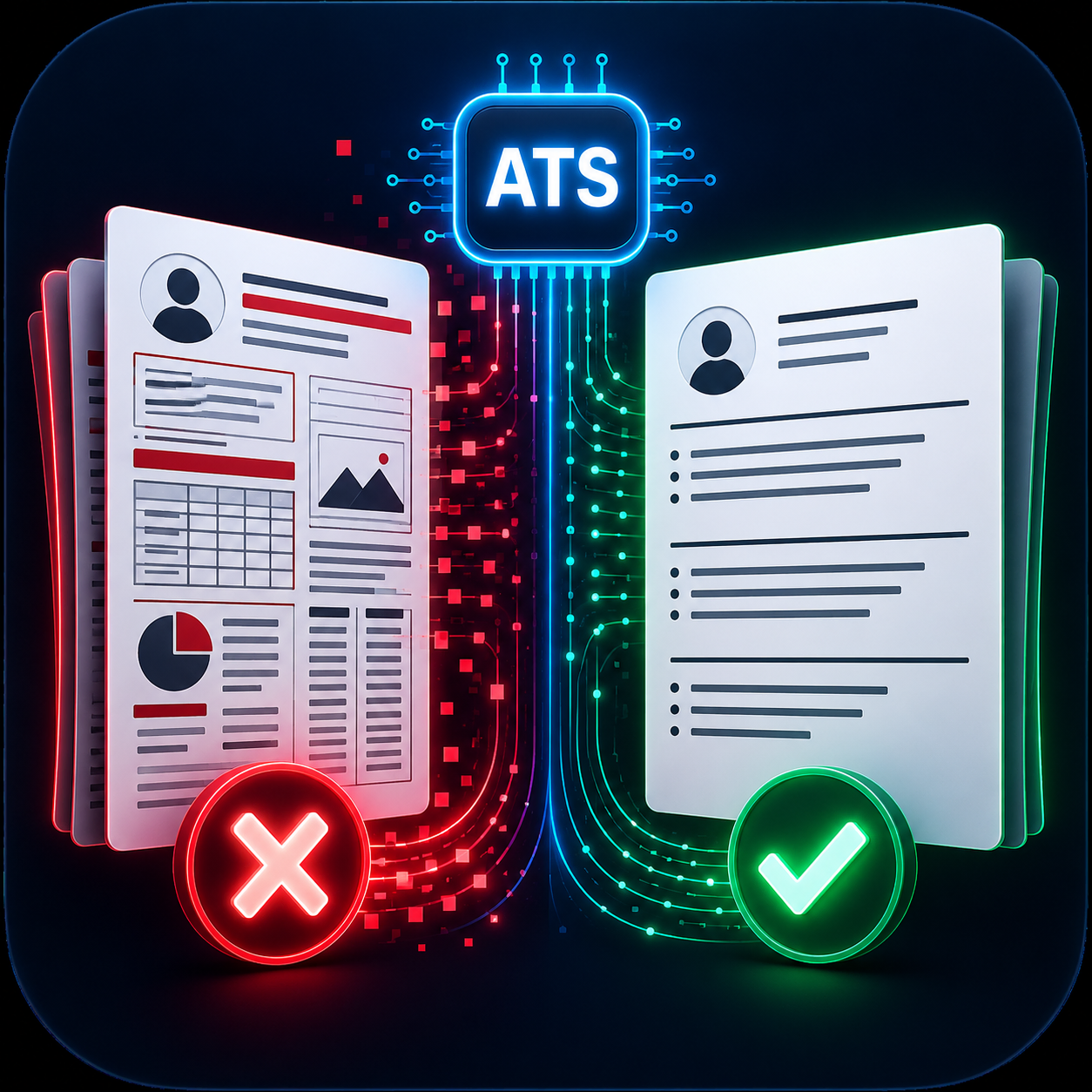
Overdesigned layouts
Tables, graphics, multiple columns, and text boxes look professional to a human eye but confuse ATS parsing. An analysis of 1,000 rejected resumes across Workday, Taleo, and Greenhouse found that DOCX files in plain text formatting had a 4% failure rate, while PDFs had an 18% failure rate, and resumes with text boxes, tables, or multi-column layouts showed dramatically higher parsing error rates. Geekflare
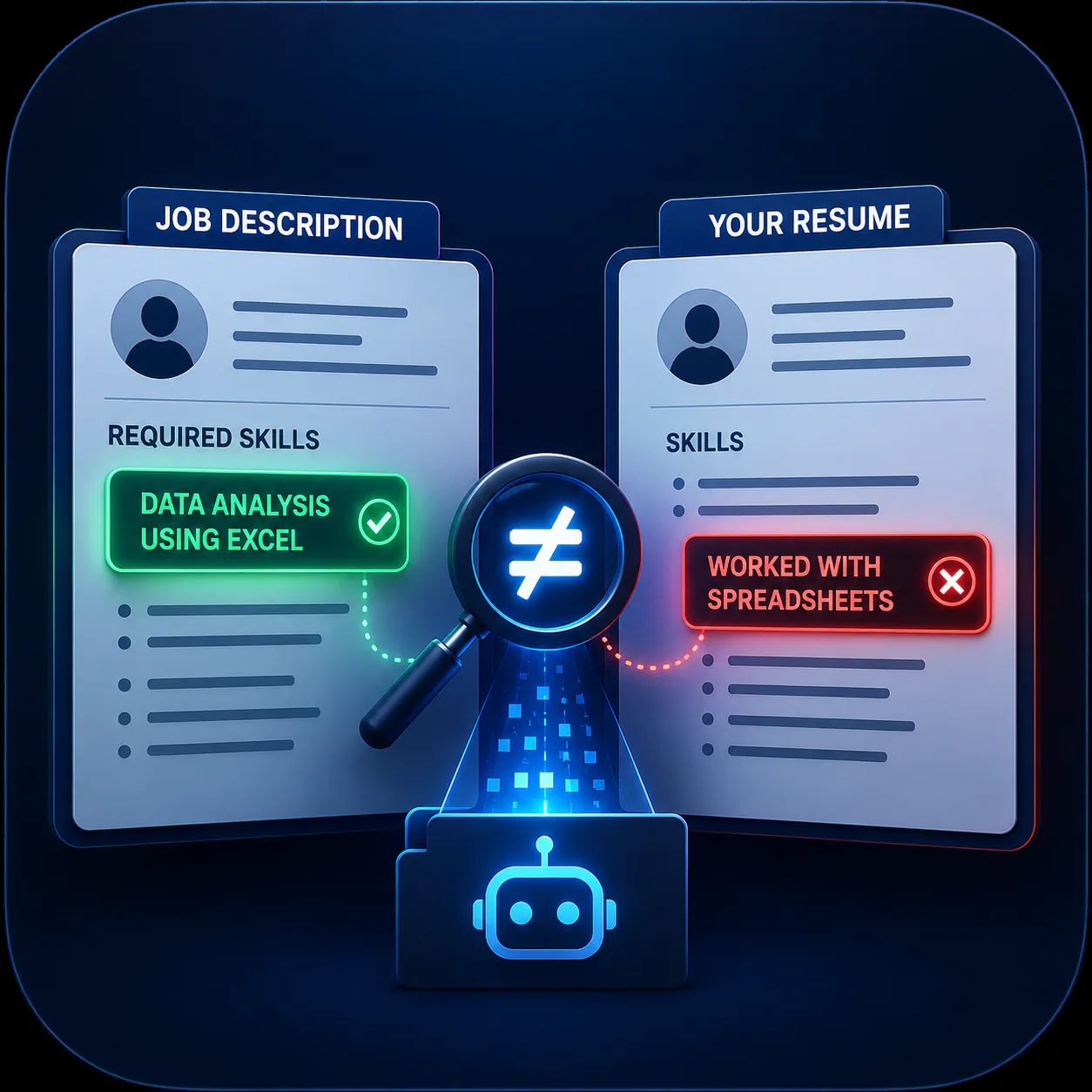
Missing or mismatched keywords
Using different language than the job description uses. If the job says "data analysis using Excel" and your resume says "worked with spreadsheets," the system may not recognize them as the same skill.
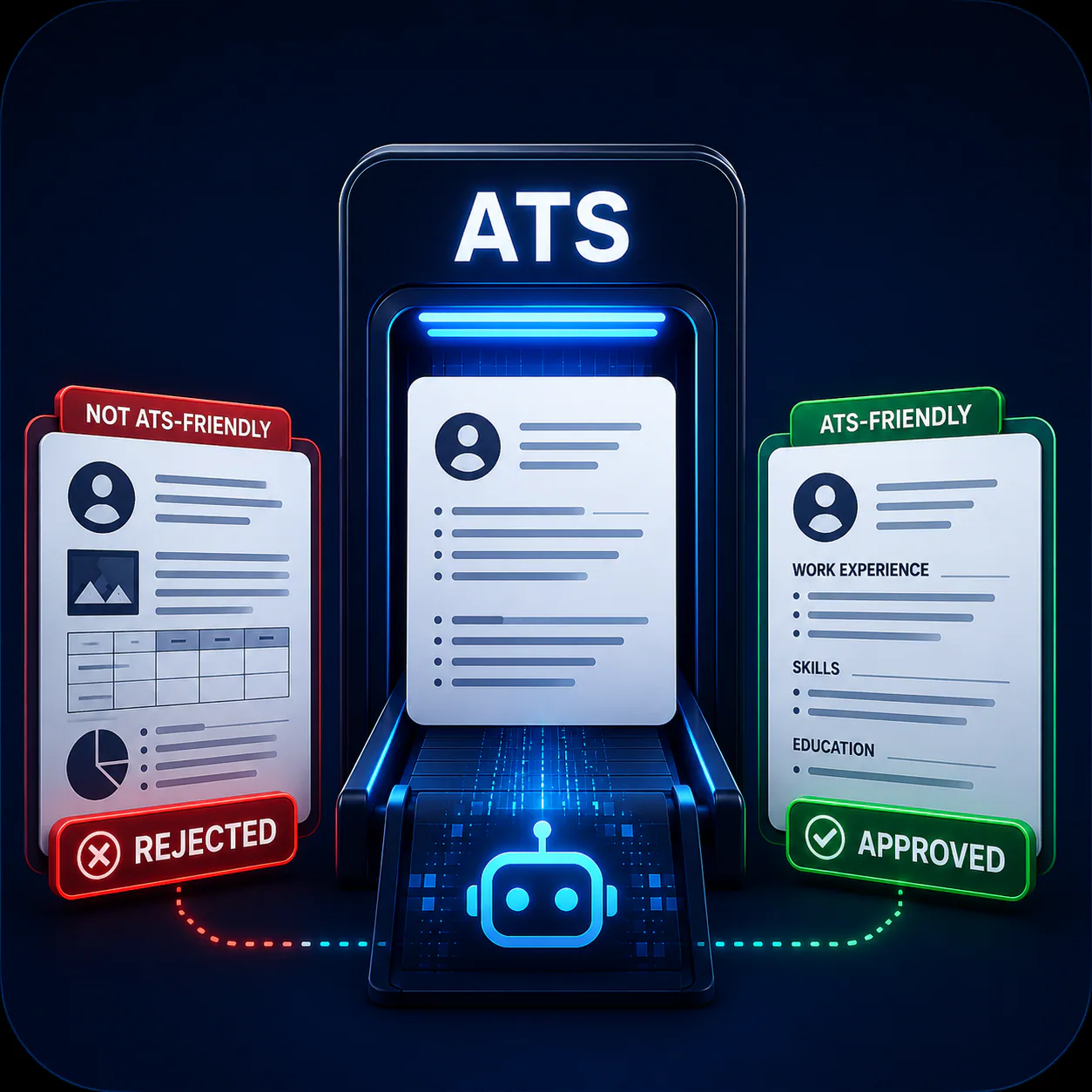
Unclear section headings
Creative labels like "What I've Done" or "My Background" may not be recognized by ATS. Standard headings like "Work Experience" and "Skills" are what the system is trained to identify.
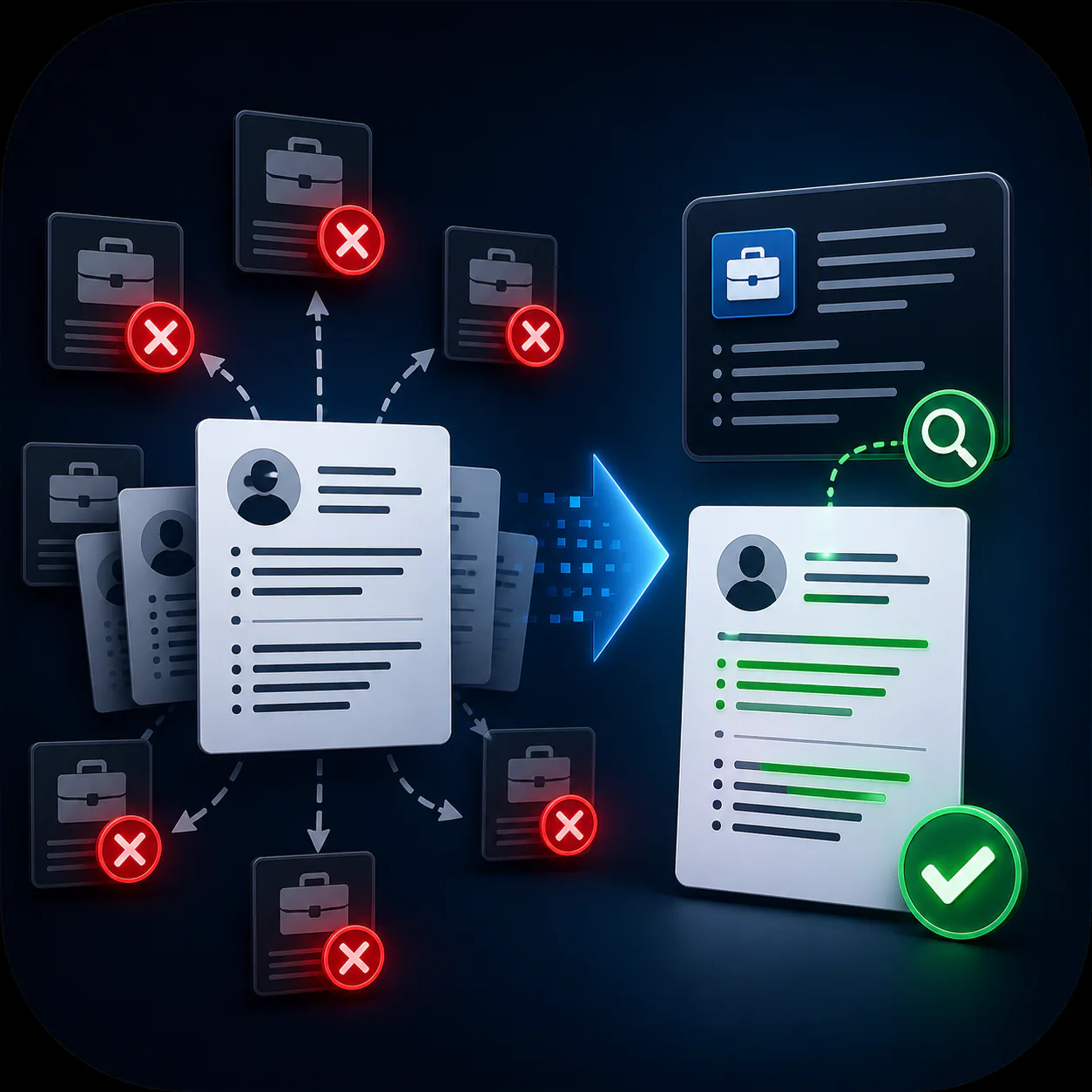
Generic resumes
Submitting the same resume to every job means it is never closely aligned with any specific role. ATS evaluates how well your resume matches one particular job description.
ATS Resume Structure
A simple, standard structure works best:
Use familiar section titles that ATS systems are trained to recognize. Avoid creative alternatives — they may be skipped during parsing.
How to Use Keywords Properly
Keywords are how ATS connects your resume to a job description. But most people misunderstand the goal.
The goal is not to add more keywords. It is to use the right ones — the specific terms the job description uses.
What are resume keywords? Resume keywords are terms from the job description that describe the skills, tools, responsibilities, and qualifications the employer is looking for.
How to use them correctly:
- Use exact phrases from the job posting — not synonyms or paraphrases
- Include them naturally in your experience descriptions, not stuffed into a list
- Do not repeat the same keyword excessively — once or twice in context is enough
- Before applying, identify two to three key phrases from the job description and verify they appear clearly in your resume
How to Extract Keywords — With Examples
Instead of guessing what keywords matter, read the job description directly and mirror its language.
Small wording differences determine whether ATS recognizes your experience as relevant to the role. The improved versions use the exact language the system is comparing against.
Why Tailoring Your Resume Matters

A resume that works for one job may not work for another. ATS evaluates how closely your resume matches a specific role — not your overall potential.
Submitting the same resume to every job consistently produces poor ATS results because no single resume is closely aligned with any particular job description. Even small adjustments — mirroring the specific terms a job posting uses — can significantly improve your ranking in the system.
The practical rule: for every application, spend five minutes reviewing the job description and adjust the language in your experience bullets to mirror what it describes. Do not fabricate experience — rephrase real experience in the language the employer uses.
ATS Resume Formatting Rules
Keep formatting simple and predictable. The more complex the design, the higher the risk of parsing errors.
Use
- Standard fonts — Arial, Calibri, Times New Roman, or similar
- Clear section headings in plain text
- Left-aligned text
- Single-column layout
- Standard bullet points
Avoid
- Tables
- Icons and graphics
- Multiple columns
- Text boxes
- Headers and footers containing contact information — ATS often cannot read content in header/footer fields
File Format
Common ATS Myths
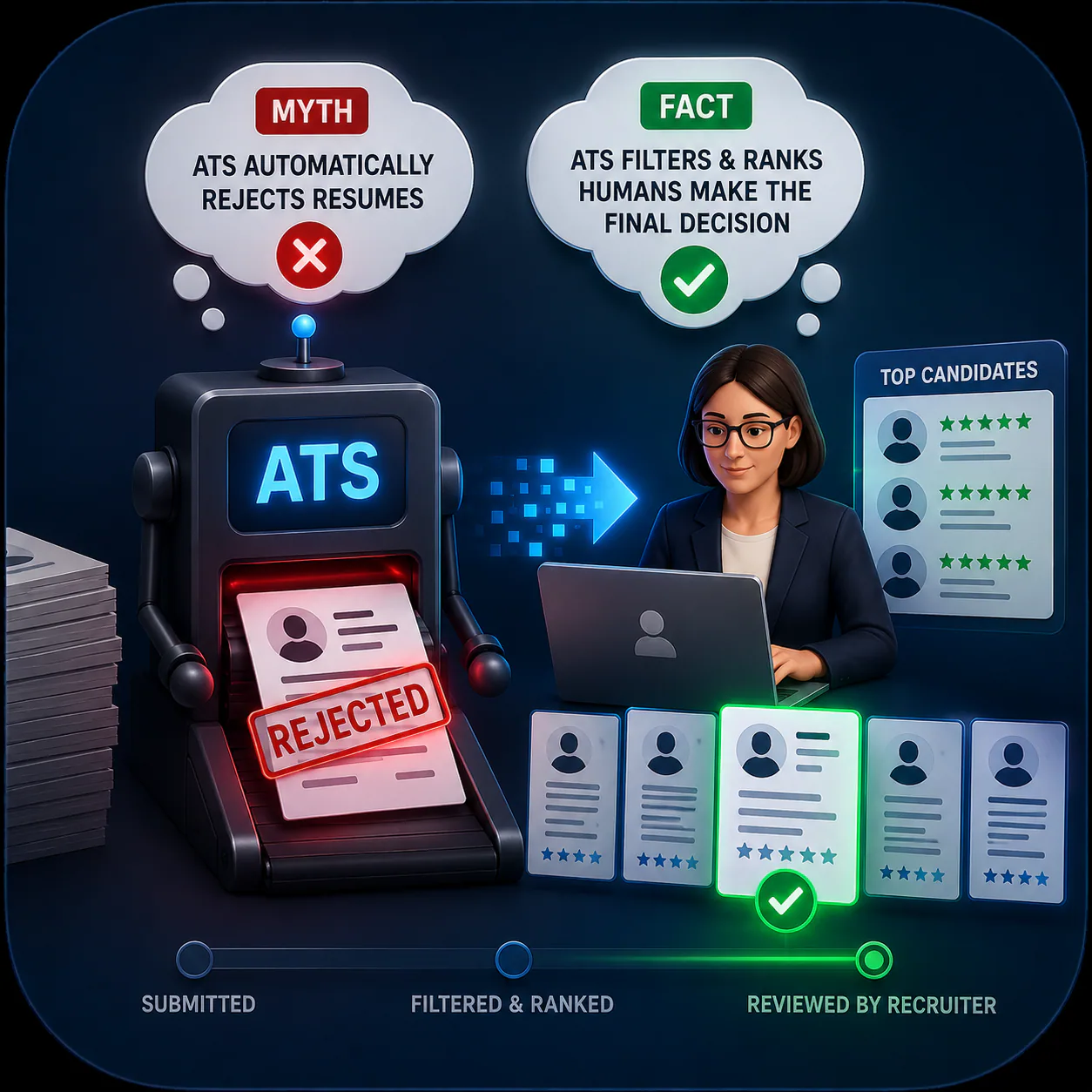
Myth 1: "ATS automatically rejects resumes"
Not exactly. ATS filters and ranks resumes — it does not make final hiring decisions. A recruiter reviews the top-ranked candidates. You are competing to be in that reviewed group, not to avoid rejection from a machine.

Myth 2: "More keywords always improve your chances"
Too many keywords make your resume unclear and repetitive — which hurts readability when the human review stage begins. Relevance and natural placement matter more than frequency.

Myth 3: "Design always hurts your resume"
Simple, clean design is fine. The problem is formatting that interferes with how ATS extracts text — tables, graphics, and multi-column layouts. A resume with consistent fonts and clear headings reads well on both ATS and human review.

Myth 4: "A great resume guarantees interviews"
A well-structured, keyword-aligned resume increases the probability of being seen. It does not guarantee an interview — that depends on your experience matching the role, the competitiveness of the applicant pool, and what the recruiter sees when they read it. ATS is the first gate, not the only one.
After ATS: What the Recruiter Sees
Passing ATS gets your resume into a recruiter's review queue. What happens next depends on a human reading it — and humans evaluate resumes differently than software.
Eye-tracking research consistently shows that a recruiter scanning a resume spends six to eight seconds on an initial pass — looking for relevant job titles, recognizable companies or contexts, evidence of results rather than just responsibilities, and overall clarity.
The same principles that help ATS — clear structure, specific language, relevant content — also help the human reviewer. A resume optimized for ATS that is also clearly written and achievement-focused passes both filters. ATS optimization and resume quality are not competing goals — they are the same goal pursued through the same approach.
Tools to Check Your Resume
Before submitting, run your resume through one of these tools:
Use these tools as a guide — not as a final authority. A high match score with poor writing still fails the human review stage. Both tools are inputs to your judgment, not replacements for it.
ATS Resume Checklist
Before submitting any application, verify:
- Uses keywords drawn directly from the job description
- Has a simple, clear single-column structure
- Uses standard section headings — Work Experience, Skills, Education
- Avoids graphics, tables, icons, and complex formatting
- Contact information is in the main body — not in a header or footer field
- File format matches what the employer requested (DOCX default when unspecified)
- Experience bullet points describe specific responsibilities and results — not just duties
- Resume has been reviewed against this specific job description — not submitted as a generic version
Frequently Asked Questions About ATS Resumes
Do all companies use ATS?
Not all, but the majority of medium and large companies do. 60% of small businesses with 1–50 employees now rely on ATS, while 80% of large organizations with 1,000+ employees use it. If you are applying to a startup or small business, ATS formatting rules still apply but are less critical. The clarity and relevance principles are always relevant regardless of company size. CoverSentry
What is the difference between ATS optimization and resume writing?
ATS optimization is specifically about ensuring the system can read your resume and match it to a job description — keywords, formatting, file type. Resume writing is the broader craft of presenting your experience, achievements, and value in a way that is compelling to a human reviewer. A strong resume does both. Neither is sufficient without the other.
Can a well-qualified candidate fail ATS?
Yes — regularly. ATS evaluates how closely the resume language matches the job description, not how capable the candidate is. A candidate with ten years of directly relevant experience who uses different language than the job posting uses will rank lower than a less experienced candidate whose resume mirrors the posting precisely. This is the core reason tailoring matters.
Does ATS treat all industries the same?
The underlying mechanics are similar across industries, but the keywords and expectations differ significantly. A resume for a technical role needs specific tool and technology terms. A resume for a creative role may need portfolio references and project types. A resume for a management role needs leadership and outcome language. The formatting rules are universal — the keyword strategy is industry and role-specific.
Conclusion
An ATS-friendly resume is not about optimizing for software. It is about clearly showing your value in a way both systems and people can understand.
When your resume is structured simply, written in the language of the role, and tailored to the specific job description, it becomes easier to evaluate at every stage — and harder to overlook.
A resume does not fail because you are not qualified. It fails when your qualifications are not clearly visible. The goal of ATS optimization is to make sure that what you actually bring is what the system and the recruiter both see.
Primary Sources
- RecruitCRM. ATS adoption and usage statistics 2026. February 2026. recruitcrm.io/blogs/applicant-tracking-system-statistics
- Jobscan. Fortune 500 ATS Usage Report — 5th Edition. 2025. jobscan.co/blog/fortune-500-use-applicant-tracking-systems
- EDLIGO. 1,000 rejected resumes analysis across Workday, Taleo, and Greenhouse. 2025. Via coversentry.com/ats-statistics
- Harvard Business School. Hidden workers: Untapped talent. 2021. Via jobscan.co
- Jobscan. Resume optimization tool. jobscan.co
About the Author
Maan C. is a Filipino writer, blogger, and self-described frustrated journalist who finally found her voice through writing. She holds a degree in psychology, a diploma in Special Education, and spent eight years in the classroom — teaching English as a Second Language to Korean students and handling preschool classes before stepping away to raise her family. After a decade as a full-time mother, she re-entered the workforce as a company-trained SEO specialist and virtual assistant, rebuilding her career from scratch before pivoting to full-time blogging. She writes about everything that genuinely interests her — technology, AI, education, careers, freelancing, travel, finance, real estate, and more — drawing from lived experience, serious research, and a lifelong habit of wanting to understand how things actually work. She describes AI as the tool that finally let her write the way she always wanted to: freely, clearly, and without holding back. Read more of her work at pixelscoop.com.
In this article, Maan draws from her own experience navigating a 10-year career gap, re-entering the workforce in a completely new field, and rebuilding income from the ground up.