Best Freelancing Platforms for Beginners (Compared)
Maan C.
May 21, 2026
14 min read



Not all freelancing platforms are built for the same type of work — or the same type of freelancer.
Some reward proactive proposal writers. Others depend entirely on marketplace visibility. Some charge 20% of everything you earn. Others charge nothing. Some attract large-budget clients with long-term project needs. Others are built around fast, low-cost transactions that close in hours.
Choosing the wrong platform doesn't mean freelancing doesn't work. It usually means you spent time in an environment that wasn't designed for your service model — and that's avoidable with the right information before you start.
This guide compares the most relevant freelancing platforms for beginners in 2026 based on verified data: user scale, fee structures, how each platform works, what competition actually looks like, and honest fit by service type. The goal is a practical decision — not a ranked list pretending one platform is universally best.
This is part of a series on starting freelancing. If you're still deciding what service to offer, how to build a portfolio, or how to approach your first 30 days — start with [How to Start Freelancing With No Experience] first. That guide covers the full foundation. This one focuses specifically on where to show up once you know what you're offering.
The best freelancing platform for beginners is the one that matches how you sell, not the one with the most name recognition. Upwork is the strongest default for broad professional services because it has active client demand and supports flexible custom work — but its 20–50 proposals per job and 0–15% fee structure require realistic expectations from the start. Fiverr suits productized creative services but a 20% flat commission and declining active buyer numbers mean early traction is harder than it looks. Contra's 0% commission is genuinely compelling but its opportunity pool is heavily weighted toward design and development, making it a poor fit for writers, VAs, and consultants. No platform removes the need for strong positioning — they just apply competitive pressure in different places.
Who This Guide Is For
- Beginners who know what they want to offer and are ready to choose where to list it
- Freelancers who have tried one platform without traction and are evaluating alternatives
- Career returners choosing between platforms for a new service type
- Anyone overwhelmed by contradictory advice about which platform is "easiest"
Quick Picks: Best Freelancing Platforms at a Glance
How to Choose the Right Platform
Most beginners ask "which platform pays the most?" That's the wrong starting question. A platform where you can't get traction pays nothing regardless of its earning ceiling. The better questions are:
What type of service are you offering? Broad custom services fit proposal-based marketplaces. Repeatable packaged services fit listing-based platforms.
Do you prefer active outreach or passive discovery? Upwork and Freelancer.com require consistent proposal activity. Fiverr depends on your listing being found organically.
How does fee structure affect your net rate? Fees directly reduce your earnings and must be factored into your pricing before you list — not after your first payout surprises you.
Are you a complete beginner or an experienced specialist? Some platforms assume proven expertise. Starting on the wrong one creates avoidable frustration.
For guidance on how your service type and pricing interact with platform choice — and for the full beginner framework before platform selection — see [How to Start Freelancing With No Experience].
1. Upwork — Best Overall for Most Beginners
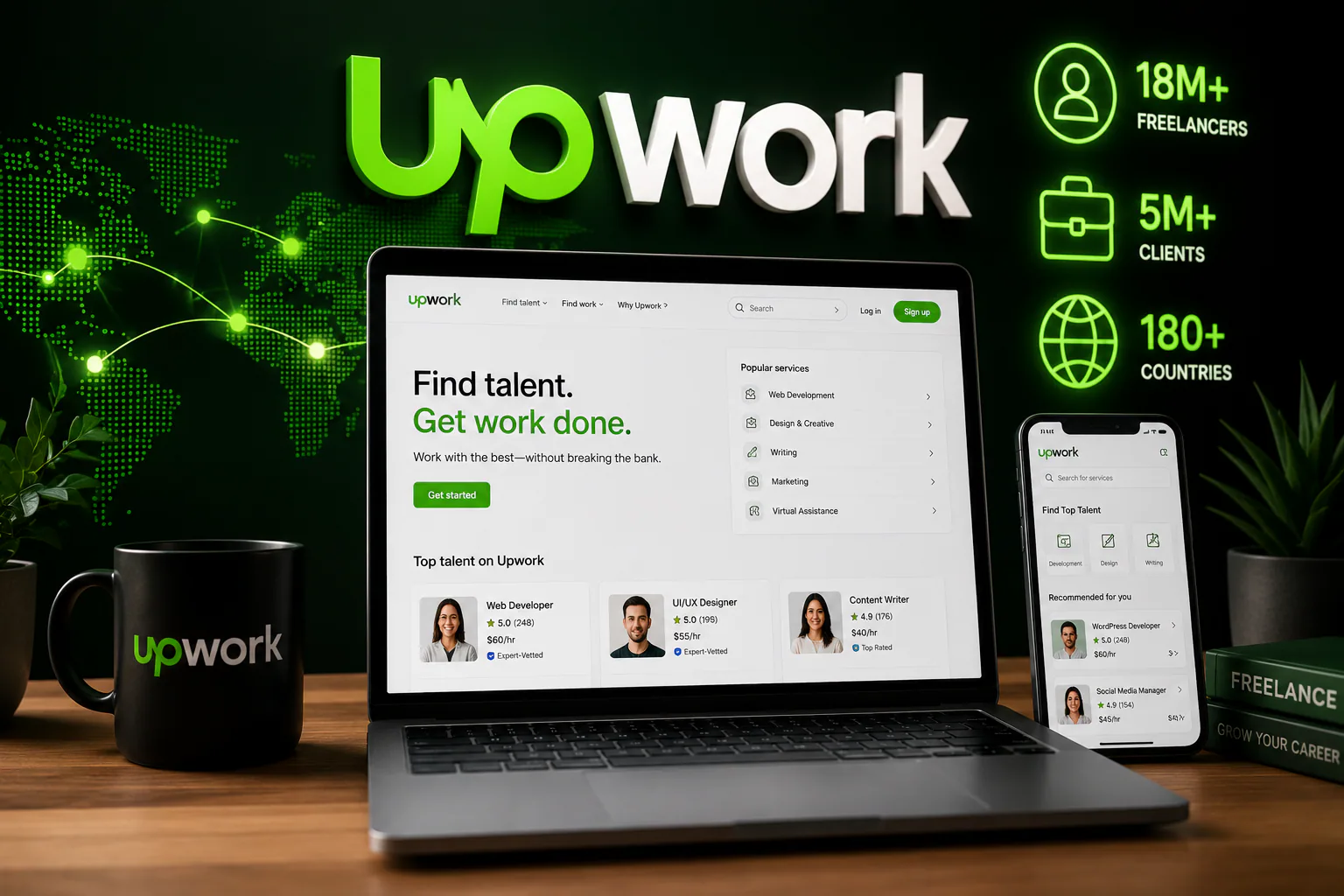
Upwork is the largest professional freelance marketplace in the world by gross services volume, hosting over 18 million registered freelancers and serving more than 5 million client businesses across virtually every professional category. Damongo
How It Works
Clients post projects. Freelancers submit proposals using Connects — 10 free per month for basic accounts, with additional Connects available at $0.15 each. Most applications cost between 2 and 6 Connects depending on project size. You pursue opportunities directly rather than waiting to be discovered.
Platform Scale
Upwork had 796,000 active clients generating over $4 billion in annual client spend in 2025, with $511.53 million in marketplace revenue in the first nine months alone. The client base skews toward larger engagements — 32% of 2026 Upwork contracts paid $1,000 or more per project, and 145,000 clients spend over $5,000 per year on the platform. BestjobsearchappsGigradar
Fees
Upwork charges a variable 0–15% freelancer commission, typically around 10% under the structure updated in May 2025, replacing the old tiered 20%/10%/5% system. Jobbers
Fee calculation in practice: To net $20/hour after Upwork's ~10% fee, quote approximately $22.22/hour. To net $30/hour, quote $33.33. Build this into your rate before listing it — not after.
Competition Reality
The average Upwork job receives between 20 and 50 proposals, with win rates for individual contracts as low as 1 in 20. Premium client postings regularly attract 100 or more applicants. As a beginner with no Job Success Score and no completed contracts, you start at a structural disadvantage. The practical entry point: target smaller, less-contested projects ($100–$500), personalize every proposal extensively, and submit within the first few hours of a posting going live. Getmany
Earning Potential
The average Upwork freelancer earns $30–$50 per hour for professional services, with top freelancers exceeding $100 per hour on complex projects. Upwork's client base supports larger, longer engagements than Fiverr — which is one of the main reasons it suits professional services better than transactional creative work. Bestjobsearchapps
Upwork Advantages
Clients are actively hiring with real budgets. Unlike listing-based platforms where you wait to be discovered, Upwork's proposal model means buyers are already expressing demand. You respond to it directly.
Broad service compatibility. Writing, consulting, virtual assistance, development, operations, research, design — Upwork handles flexible custom work better than any other platform on this list.
Stronger long-term relationship potential. Because projects often involve direct communication and evolving scope, longer client relationships are possible. Upwork reports 97%+ contract payout success — a meaningful trust signal for beginners worried about non-payment. Bestjobsearchapps
Upwork Limitations
Active effort is non-negotiable. Creating a profile and waiting produces almost no results. The platform rewards consistent, targeted proposal activity.
Competition is real and visible. Silence after proposals stings more than invisible competition on a listing platform. Beginners who treat proposal rejection as evidence freelancing doesn't work often quit before the momentum builds.
Connects cost money. Active proposal submission requires purchasing beyond the 10 free monthly Connects once you're applying consistently. Factor this into your cost of doing business.
Who Should Choose Upwork
Writers, virtual assistants, consultants, admin support specialists, developers, marketers, researchers, and operations freelancers — anyone whose service benefits from custom scope conversations, client relationship-building, and project variety. If your work doesn't fit neatly into a fixed package, Upwork is almost always the right starting point.
For a detailed head-to-head comparison of Upwork versus Fiverr — including full fee math, client quality differences, earning averages, and which one fits your service type — see [Upwork vs Fiverr for Beginners].
2. Fiverr — Best for Productized Creative Services

Fiverr operates on a fundamentally different model. Freelancers create service listings (gigs) that buyers browse and purchase directly. Fiverr receives over 80 million monthly visitors, creating genuine discovery potential for well-positioned listings. Damongo
How It Works
Create a service listing → buyer discovers it → buyer places an order → work begins. No proposal required. The platform rewards clear packaging and listing optimization over outreach skill. For beginner creative freelancers with a defined deliverable, this can feel more natural than Upwork's proposal workflow.
Platform Scale
Fiverr's active buyer count has declined from a peak of 4.28 million to approximately 3.5 million as of Q1 2025 — an important correction from the widely cited 5.5 million figure, which was a data error in multiple secondary sources. Average spend per buyer sits at approximately $342 per year — higher volume but significantly lower per-engagement spend compared to Upwork's client base. Jobbers
Fees
Fiverr charges sellers a consistent 20% commission on all earnings. Buyers pay a minimum 5.5% fee on each transaction, with an additional $3.50 assessed on orders under $200. Upwork
Fee calculation in practice: To net $20/hour after Fiverr's 20% fee, quote $25/hour. On a $500 project, Fiverr retains $100, leaving you $400. On a $50 gig, Fiverr retains $10, leaving you $40. At lower price points where many beginners start, the 20% compression is significant.
Annual fee impact: On $60,000 in annual earnings, the difference between Fiverr's 20% ($12,000 in fees) and Upwork's typical 10% ($6,000 in fees) is $6,000 per year. That gap widens as income grows.
Competition Reality
Fiverr competition happens at the listing level rather than the proposal level. A new listing with no reviews starts with very little algorithmic support — the platform surfaces established sellers with review history first. Many beginners underestimate how long it takes to build initial organic visibility. Early traction often requires self-promotion through social channels rather than relying purely on Fiverr's internal discovery.
Fiverr Advantages
Simpler setup conceptually. Create an offer, publish it, let buyers find it. For beginners who dislike constant proposal writing, this structure is genuinely appealing.
Strong for repeatable services. Logo design packages, short-form video editing, resume writing, voiceover work, social media graphics, presentation design — if your offer is fixed and deliverable-focused, Fiverr's structure aligns naturally.
Discovery can become passive over time. Once a listing gains traction and review history, inbound inquiries can happen without active effort. Getting to that point requires patience and early investment in listing quality.
Fiverr Limitations
The 20% fee compounds quickly. At lower price points where many beginners price to win first clients, the commission is proportionally painful.
Less suitable for complex or custom work. If your service requires scope conversations, evolving deliverables, or client discovery before quoting, Fiverr's listing structure creates friction.
Buyer count is declining. The platform is actively working to shift toward higher-value buyers through Fiverr Pro and enterprise features, but the mass-market buyer volume that defined Fiverr's early years has been shrinking.
Who Should Choose Fiverr
Designers, video editors, voice artists, resume writers, presentation designers, and productized creative freelancers — anyone whose offer can be defined as a fixed, repeatable deliverable. If you can describe your service as "X deliverable delivered in Y days for Z price," Fiverr's structure fits.
For a complete side-by-side analysis of how Upwork and Fiverr differ — including which one has better clients, how the fee gap affects real take-home pay, and a decision framework for your specific service type — see [Upwork vs Fiverr for Beginners].
3. Freelancer.com — Best Alternative Global Marketplace
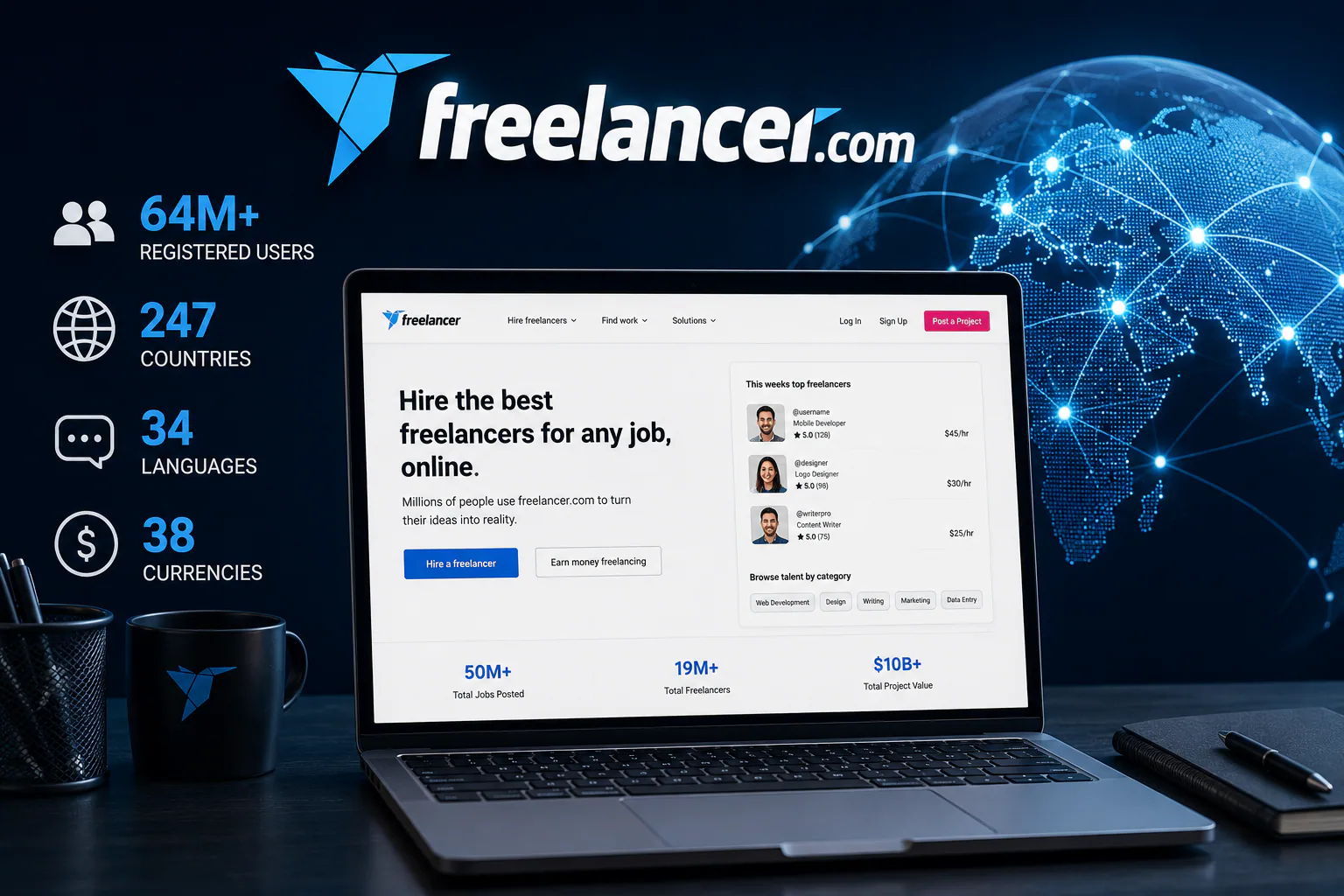
By 2023, Freelancer.com had over 64 million registered users across 247 countries, regions, and territories — covering 34 languages and 38 currencies. It operates similarly to Upwork — clients post projects, freelancers bid — with the addition of a contest model for creative projects where clients review multiple submissions before selecting a winner. Skillademia
Fees
Freelancer.com charges 10% or a $5 minimum from freelancers. Lower than Fiverr's 20%, comparable to Upwork's typical rate. Jobbers
How It Works
Clients post projects. Freelancers bid. Projects are awarded to selected applicants. The contest model works well for design and creative categories where clients want to compare options before committing — logo design, web design, graphic assets. Standard bidding covers everything else.
What It Offers
Broad category coverage and genuine global reach — particularly useful for freelancers in markets where Upwork and Fiverr have lower client penetration. Some categories are less saturated here than on Upwork, which can matter for beginners competing without an established profile. The platform is more practical as a secondary channel than a primary starting point, but worth including in your strategy once your primary platform is working.
Limitations
Bidding competition can be aggressive in popular categories. Marketplace quality varies more than on Upwork — client vetting is less rigorous, and some projects reflect very low budgets. Filtering carefully for serious clients with payment verification and clear project descriptions is important.
Who Should Choose Freelancer.com
Generalist freelancers wanting an additional marketplace option, particularly in international markets or categories where Upwork feels oversaturated. Most effective as a secondary channel rather than a primary starting point.
Midpoint Orientation
If you are still choosing between the first three: Upwork for broad professional services and custom work; Fiverr for packaged creative deliverables; Freelancer.com as a supplementary global channel.
For a direct head-to-head between the two most popular options, see [Upwork vs Fiverr for Beginners]. For the full beginner framework — including service selection, portfolio building, and client acquisition strategy — see [How to Start Freelancing With No Experience].
4. Contra — Best for Creatives Who Want 0% Fees

Contra has over 1.2 million creatives and has facilitated over $200 million in commission-free payments since launching in 2019, backed by $45 million in venture funding. Its defining feature is exactly what it sounds like: zero commission for freelancers on all earnings. Damongo
Fee Structure
Contra charges freelancers 0% commission. Clients pay Stripe transaction fees (typically 2.9% + $0.30) plus potential platform service fees. An optional Pro subscription costs $29/month and unlocks enhanced features including priority placement and Indy AI — a Chrome extension that scans your LinkedIn and X network for relevant freelance opportunities based on your skills and profile. Jobbers
Fee calculation in practice: On $60,000 in annual earnings, switching from Fiverr's 20% to Contra's 0% saves $12,000 per year. Switching from Upwork's ~10% saves $6,000. For creatives who find consistent work on the platform, the fee savings are substantial.
The Critical Limitation
Zero commission only matters if work exists. Contra's job listings are limited and heavily weighted toward designers, Webflow developers, and animators. For writers, virtual assistants, music professionals, and most non-creative categories, the platform's job volume is currently too low for reliable income. Ebaqdesign
Contra works best for creatives who already have some network or social presence to drive initial engagement. As a cold-start beginner platform across most service categories, the limited job volume is a genuine constraint that the 0% fee doesn't overcome. If you can drive your own clients to the platform, the fee advantage is compelling. If you're relying purely on platform discovery, the opportunity pool is too thin for most service types.
Contra Advantages
Zero commission is genuinely meaningful. Unlike platforms that incrementally reduce fees over time as you earn more with a client, Contra's 0% applies from the very first dollar on every project.
Professional portfolio-first presentation. Contra's profile design prioritizes visual work presentation in a way that traditional marketplaces don't — appealing to designers and creatives who want their work to lead rather than their proposal text.
Indy AI is a differentiating feature. The ability to surface relevant opportunities from your existing professional network rather than browsing job boards is a meaningfully different model from every other platform on this list.
Who Should Choose Contra
Designers, developers, animators, and video editors who want to avoid platform commissions and are willing to self-promote. Most effective as a secondary platform for creatives once their primary platform service is established — not recommended as a first platform for writers, VAs, consultants, or administrative freelancers.
5. Toptal — For Experienced Specialists Only

Toptal accepts only the top 3% of applicants through a multi-stage screening process and charges freelancers 0% commission, adding its margin on the client side. Jobbers
The Screening Process
The vetting involves a language and communication assessment, an in-depth skills review, a live screening interview, and a test project — a process that typically takes several weeks. Developers, designers, finance experts, and project managers who pass gain access to enterprise-level clients at premium rates.
Why Beginners Should Not Start Here
The entry barrier is not cosmetic. Toptal's vetting is specifically designed to filter for proven professional expertise. A beginner without a demonstrable track record will not pass the screening and will waste time and momentum attempting it. This is a long-term aspirational platform for established specialists — not a first stop.
Who Should Choose Toptal
Experienced developers, designers, finance experts, and consultants with three or more years of relevant professional experience and a portfolio of demonstrable results. Worth pursuing once your track record is strong enough to be competitive in their screening.
6. PeoplePerHour — Best for UK-Oriented Freelancers

PeoplePerHour is an established marketplace with particular strength in the UK and European markets. Its structure combines project listings and buyer requests across a broad range of service categories.
Fees
PeoplePerHour charges up to 20% on initial earnings with each buyer, dropping to lower rates as the relationship grows — a sliding scale that rewards long-term client relationships over one-off transactions. Jobbers
What It Offers
Broader geographic penetration in UK and European markets than Upwork or Fiverr achieve in those regions. Less global competition in some categories — a genuine advantage for beginners who find Upwork too saturated. A practical alternative for freelancers in or targeting those markets specifically.
Limitations
Lower global mindshare than the dominant platforms means lower overall client volume. Less useful for freelancers primarily targeting North American or Asian clients.
Who Should Choose PeoplePerHour
Writers, developers, designers, and marketers with a preference for or specific relevance to UK and European clients. A practical secondary marketplace for the right geographic context.
7. Guru — Best Supplementary Marketplace

Guru is one of the older platforms in the freelance ecosystem. It operates across a broad range of categories with a workroom-based project management approach that some freelancers find more structured than standard marketplace interactions.
Fees
Guru charges freelancers 5–9% depending on membership tier — lower than both Upwork and Fiverr at standard rates, which is meaningful for freelancers who find traction there. Jobbers
What It Offers
Broad category coverage. A lower-fee structure than the dominant platforms. Less mainstream traffic than Upwork or Fiverr means lower client volume overall, but also less intense proposal competition in some categories. Most effective as a secondary channel once your primary platform is generating consistent results.
Who Should Choose Guru
Generalist freelancers looking for an additional low-fee marketplace channel. Not typically the strongest first choice, but a reasonable supplementary option worth adding to your platform mix once your primary platform is working.
Platform Fee Comparison
Understanding fees before choosing a platform is essential — not an afterthought.
Annual fee impact at $60,000 earnings:
- Fiverr (20%): $12,000 in fees annually
- Upwork (~10%): $6,000 in fees annually
- Contra/Toptal (0%): $0 in fees annually
The fee gap is not a minor detail. Over five years at $60,000 annually, the difference between Fiverr and a zero-commission platform is $60,000. That compounds further as income grows.
For a detailed calculation of exactly what to quote on each platform to hit your target net rate — and how fees interact with your beginner pricing strategy — see [Freelance Pricing Guide for Beginners].
Platform Decision Checklist
Before choosing a platform, answer these:
- Can my service be packaged into a fixed deliverable? If yes, Fiverr is viable. If no, Upwork is the better structural fit.
- Am I comfortable writing personalized proposals repeatedly? If no, Fiverr removes that requirement.
- Does my pricing absorb the platform fee without hurting sustainability? If not, the fee difference between platforms matters.
- Do I need custom scope conversations before quoting? If yes, Upwork handles that better structurally.
- Am I targeting UK or European clients specifically? If yes, consider PeoplePerHour as a secondary channel.
- Do I have an existing creative network I can leverage? If yes, Contra's 0% commission becomes genuinely compelling.
- Am I willing to build slowly without guaranteed early visibility? Both Upwork and Fiverr require this — set expectations accordingly.
Which Platform by Freelancer Type
Common Beginner Platform Mistakes

Choosing based only on popularity.
A platform being famous doesn't make it the right fit for your service. The better question is whether the platform structure matches how you sell.

Expecting passive success.
Every major platform requires active effort — proposal writing, listing optimization, self-promotion, or some combination. Creating a profile and waiting produces minimal results on any platform.

Picking a platform that doesn't fit your service type.
Trying to force consulting-style work into a productized gig model creates friction that isn't about you — it's about fit.

Joining too many platforms immediately.
More platforms equal more fragmented effort. Start with one or two strong-fit platforms and learn them well before expanding.

Competing only on price.
Low pricing attracts attention but rarely attracts the right clients. Price is not positioning.
For a full breakdown of beginner mistakes across the freelancing process — including portfolio building, proposals, and client communication.
Frequently Asked Questions
What is the best freelancing platform for beginners?
For most beginners offering broad professional services, Upwork is the strongest starting point because clients are actively posting projects and the platform supports flexible custom work. Upwork serves more than 5 million client businesses with over 18 million registered freelancers — the deepest pool of active buyer demand of any platform reviewed here. Productized creative freelancers may find Fiverr a better structural fit. For the full head-to-head between those two platforms, see [Upwork vs Fiverr for Beginners]. Damongo
Which freelance platform charges the lowest fees?
Contra charges 0% from freelancers — the lowest of any platform reviewed. Upwork's typical rate is approximately 10%, Freelancer.com charges 10% or a $5 minimum, and Fiverr charges a flat 20%. Zero commission only matters if the platform has sufficient client volume for your service category — Contra's job listings skew heavily toward design and development. For how to build platform fees into your pricing from the start, see [Freelance Pricing Guide for Beginners]. Jobbers
Is Fiverr easier than Upwork for beginners?
Structurally, Fiverr is simpler to set up — no proposal writing required. But Fiverr's active buyer count has declined from a peak of 4.28 million to approximately 3.5 million, and new listings start with minimal algorithmic support. "Easier to set up" and "easier to get traction on" are different things. For a full breakdown of both, see [Upwork vs Fiverr for Beginners]. Jobbers
Should beginners join multiple platforms simultaneously?
Not immediately. Starting with one or two strong-fit platforms and learning them well produces better results than shallow activity spread across five. Most successful freelancers start concentrated and expand once they have a working system on their primary platform.
Is Contra worth it for beginners?
Contra's listings are limited and skew heavily toward designers, developers, and animators — making it genuinely unsuitable for writers, VAs, and most non-creative beginner categories. For designers and developers, the 0% commission makes it a compelling secondary channel. For most other service types, the job volume limitation outweighs the fee advantage until you can drive your own client traffic to the platform. Ebaqdesign
What makes Toptal different from other platforms?
Toptal accepts only the top 3% of applicants and charges freelancers 0% commission, building its margin on the client side. It requires demonstrated expertise and multi-stage vetting — not accessible to beginners. Think of it as a long-term goal for when your track record is strong enough to be competitive in their screening. Jobbers
How do I factor platform fees into my rates?
Quote your target net rate divided by (1 minus the fee percentage). To net $20/hour: on Upwork quote $22.22 (÷ 0.90), on Fiverr quote $25.00 (÷ 0.80), on Contra quote $20.00 (÷ 1.00). For a full walkthrough of beginner pricing by service type and how market rates interact with platform fees, see [Freelance Pricing Guide for Beginners].
Conclusion
The best freelancing platform for you is the one that matches how you actually work — not the one with the most recognition, the lowest fees on paper, or the most online discussion.
Upwork is the strongest default for broad professional services. Fiverr suits packaged creative deliverables. Contra offers fee-free earnings for creatives with existing networks. Toptal is a long-term target for specialists with proven track records. Freelancer.com, PeoplePerHour, and Guru are legitimate secondary channels worth adding once your primary platform is generating results.
Choose one platform that fits your service model, learn it deeply, and build before expanding.
Primary Sources
- Upwork. In-Depth Comparison: Upwork vs. Fiverr 2026. May 2026. upwork.com/resources/upwork-vs-fiverr
- Upwork SEC Filings / Backlinko. Active client and annual spend data 2025. Via bestjobsearchapps.com
- Fiverr Investor Relations. Annual active buyer count Q1 2025. Via jobbers.io/fiverr-vs-upwork comparison
- GigRadar. Upwork vs Fiverr Fee Math + Free Calculator 2026. April 2026. gigradar.io/blog/upwork-vs-fiverr-compare
- Getmany. Upwork Bidding Mastery 2025: Proposals, Win Rates, and Competition. December 2025. getmany.com/blog/upwork-bidding-mastery-2025
- Damongo. Best Freelance Platforms in Mid-2026. May 2026. damongo.com
- Jobbers.io Research Team. Freelance Platform Statistics 2026. April 2026. jobbers.io/freelance-platform-statistics-2026
- Skillademia. Freelancer.com Statistics 2025. April 2025. skillademia.com/statistics/freelancer-com-statistics
- Ebaqdesign. Contra vs Fiverr vs Upwork: Which is Best? January 2026. ebaqdesign.com/blog/contra-fiverr-upwork
- Jobbers.io. Which Freelance Platform Has No Commission in 2026. December 2025. jobbers.io

About the Author
Maan C. is a Filipino writer, blogger, and self-described frustrated journalist who finally found her voice through writing. She holds a degree in psychology, a diploma in Special Education, and spent eight years in the classroom — teaching ESL to Korean students and handling preschool classes before stepping away to raise her family. After a decade as a full-time mother, she re-entered the workforce as a company-trained SEO specialist and virtual assistant, rebuilding her career from scratch before pivoting to full-time blogging. She writes about technology, AI, education, careers, freelancing, travel, finance, real estate, and more. Read more at pixelscoop.com.
In this article, Maan draws from her own experience navigating a 10-year career gap, re-entering the workforce in a completely new field, and rebuilding income from the ground up. Read more at pixelscoop.com.