
How to Start Freelancing With No Experience: A Beginner's Step-by-Step Guide
Maan C.
May 21, 2026
14 min read




Freelancing has become one of the most accessible ways to earn income independently — whether you want to replace a full-time salary, build a side income, or create a more flexible work life. But for beginners, the process often feels uncertain.
The market context is worth understanding before anything else. 36% of knowledge workers currently holding full-time jobs are actively considering freelancing, and 78% of CEOs assert that their top freelancers contribute as much or more value than degree-holding employees. In the U.S., the freelance workforce grew by 90% between 2020 and 2024 — and that growth has not slowed. The demand is real. The challenge for most beginners is not whether freelancing works, but how to get positioned correctly within it. UpworkMellow
Most beginner guides oversimplify the process. They tell you to pick a skill, sign up for a platform, and send proposals — skipping the practical decision-making that actually determines whether you gain traction: choosing a service people pay for, validating demand before committing, building a credible portfolio without client work, and protecting yourself from the most common and expensive beginner mistakes.
This guide is the master reference for starting from scratch. Each step points to dedicated deep-dive guides when the topic warrants more than an introduction — because some decisions, like pricing and platform selection, deserve their own full treatment.
Starting freelancing with no experience is a positioning problem, not a credentials problem — most beginners already have transferable skills, they just haven't framed them as services yet. The first paid project matters more than perfection: new freelancers who complete a first paid project within their first month are nearly three times more likely to still be actively freelancing a year later. Income starts low and grows on a curve — the median new freelancer earns around $180 in month one and $3,500 by month twelve, which means early results are not the measure of long-term viability. Scope clarity and written agreements prevent the majority of beginner disputes before they start. Warm network outreach almost always produces the fastest first client — faster than any platform.
Who This Guide Is For
- Complete beginners with no freelance history but transferable skills
- Students exploring income options alongside study
- Career switchers repositioning existing expertise as independent services
- Stay-at-home parents or career returners rebuilding income from scratch
- Anyone who has tried freelancing briefly without traction and wants a structured approach
Quick Answer: How Do You Start Freelancing With No Experience?
- Identify a skill you can turn into a specific, sellable service
- Validate that real demand exists before committing
- Build a small portfolio using sample or self-created work
- Create a professional online presence — profile, portfolio, positioning statement
- Choose the right platform or outreach channel for your service type
- Find clients through platforms, direct outreach, or your existing network
- Send tailored proposals rather than generic applications
- Set clear pricing, scope, and payment expectations before work begins
- Deliver professionally and use early projects to build credibility
The biggest beginner mistake is assuming experience must come first. Most beginners don't have zero experience — they have transferable skills they haven't yet framed as services.
What Freelancing Actually Means
Before choosing platforms or building a portfolio, it helps to define what freelancing actually is — because several common misconceptions cause beginners to set incorrect expectations from the start.

Freelancing means offering services independently to clients on a contract or project basis rather than working as a permanent employee. In practical terms, a freelancer is responsible for finding clients, setting rates, defining scope, delivering work, managing communication, and handling invoices and payments.
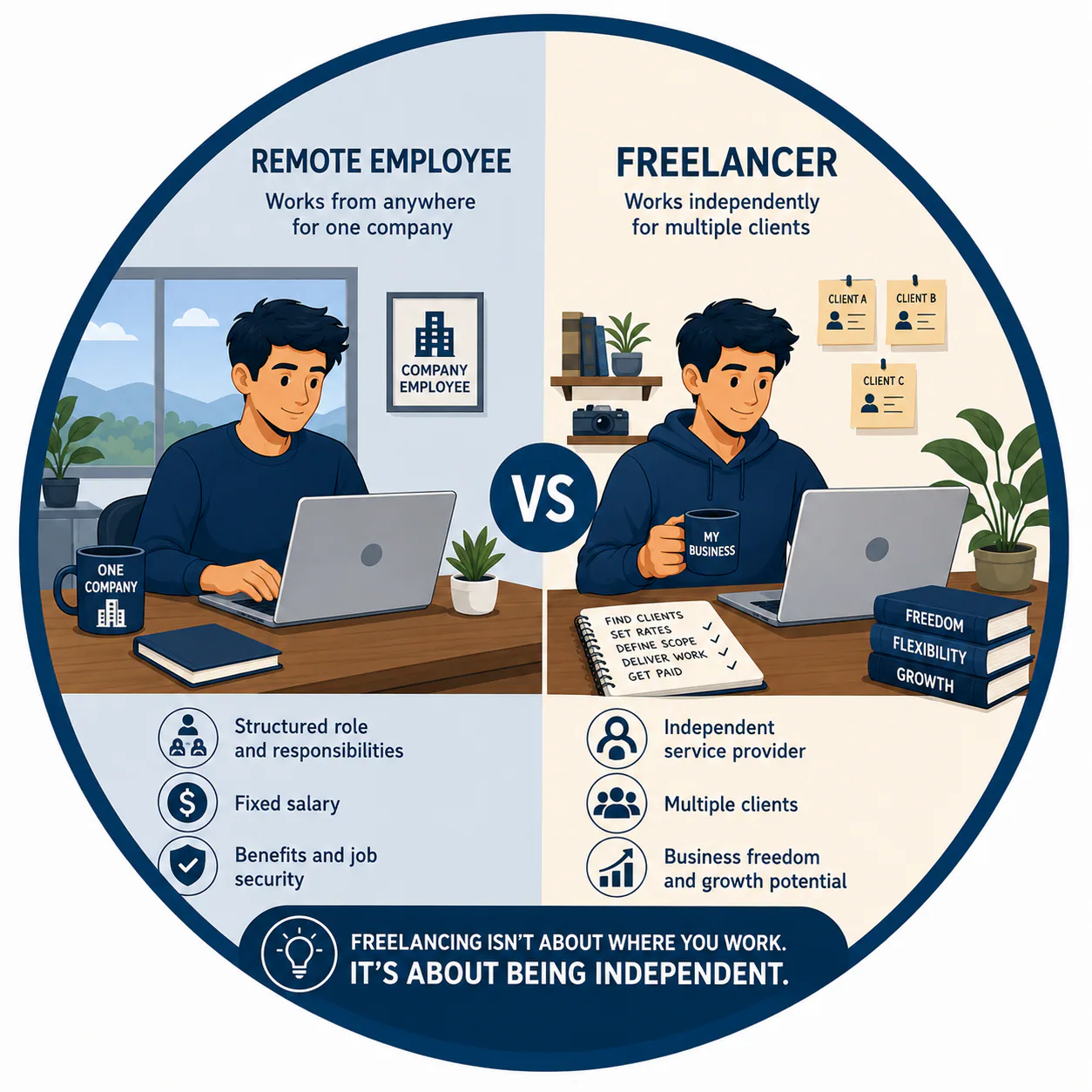
Freelancing vs remote employment. A remote employee works from anywhere but remains employed by one company with structured responsibilities and fixed compensation. A freelancer operates as an independent service provider. Location flexibility is not what makes something freelancing — business independence is.

Freelancing vs gig work. Gig work involves short, transactional tasks: food delivery, rideshare driving, microtasks. Freelancing involves skill-based services with client relationships — writing, design, development, consulting, virtual assistance, bookkeeping. The distinction matters because freelancing offers greater pricing control, stronger long-term earning potential, and more specialization opportunity.
Is freelancing a business? Functionally, yes — even at small scale. You don't need a formal company structure immediately, but you do need a service-business mindset. Clients are not paying for effort. They are paying for outcomes.
Can You Really Start With No Experience?

Yes — but "no experience" needs clarification. Most beginners don't have zero relevant skills. They usually mean: no freelance history, no paid client work, no formal portfolio, no degree in the field, or no professional network in the industry. Those are different from having nothing to offer.
A student who has organized campus events may have project coordination skills. A stay-at-home parent may have scheduling, communication, and administrative strengths. A former employee may have operational expertise that translates directly to consulting. A hobbyist designer may have execution ability without commercial work to show yet.
The real question is not "Have I freelanced before?" It is "Can I solve a specific problem for a client?"
What clients actually care about. Most clients hire because they need a problem solved, not because they want the most experienced option. Relevance and demonstrated capability often matter more than years of history. Nearly 90% of freelancers surveyed said their clients want professionals with specialized skills and expertise — which means focused ability in one area consistently outperforms broad but shallow experience. Mellow
Where "no experience" is genuinely a barrier. Specialized legal advisory, regulated financial services, advanced technical consulting, and medical consulting require legitimate expertise. Most beginner-accessible categories — writing, admin support, design, research, social media, customer support — don't carry the same barriers. That's where most new freelancers should focus first.
Step 1: Choose a Service Based on Skills You Already Have
The wrong starting question is "What freelance job is easiest?" That leads to copying crowded advice. The better question is "What problems can I realistically help someone solve?"
Beginner-Friendly Digital Services
Professional Services for Experienced Workers
If you are transitioning from employment, your existing expertise may be significantly more valuable than entry-level digital services.
A Better Service Selection Filter
Before committing, ask: Can I learn this to usable competence reasonably quickly? Do businesses actively pay for it? Can I produce visible proof of ability? Would I be willing to do this repeatedly? If yes across all four, the service is worth pursuing.
Step 2: Validate Demand Before You Commit
Many guides say "pick a skill and start." That can waste weeks on a service with no real buyer demand.
Check freelance marketplaces. Browse Upwork, Fiverr, and Freelancer.com. Are clients actively posting projects in this category? Are budgets serious? What deliverables are buyers requesting most often?
Check job boards for adjacent demand. If businesses repeatedly hire full-time for a skill, there is almost always freelance demand for it too.
Check community conversations. Founder communities, Reddit, and business forums surface real frustrations — consistent complaints about content bottlenecks, admin overload, or social media inconsistency are demand signals worth noting.
The difference between preference and validation: Weak thinking: "I enjoy graphic design, so I'll freelance in it." Better thinking: "I can see active demand for logo design, social graphics, and ad creatives across multiple platforms and business communities." One is a preference. The other is market confirmation.
Step 3: Build a Portfolio Without Client Work
The belief that a portfolio only counts if a paying client commissioned it stops more beginners than almost anything else. It is not true.
A portfolio is proof that you can produce relevant work — not proof that someone paid you. For most beginner-accessible services, self-created samples are a completely legitimate starting point.
What your first portfolio needs to do: Answer three practical client questions — Can this person do the work? Do they understand what outcome I need? Is their work usable? Relevance matters more than quantity. Three strong examples consistently outperform fifteen weak ones.
Portfolio Options When You Have No Clients
Self-initiated sample projects. Create work that reflects the type of projects you want to be hired for.
- A content writer can create: blog articles, landing page copy, product descriptions, email sequences
- A designer can create: social media graphics, homepage redesign concepts, ad creatives, presentation layouts
- A virtual assistant can showcase: workflow systems, scheduling templates, inbox management examples
- A bookkeeper can present: anonymized sample financial workflows, spreadsheet templates
Redesign concepts (clearly labeled). Reimagine a weak real-world example as a conceptual redesign. Always present these transparently — misrepresentation damages trust immediately.
Volunteer or low-stakes experience. Student organizations, community projects, nonprofits, and family business support can build legitimate proof — especially useful for social media, operations, admin, and writing services.
Process documentation. For operational services like project management or virtual assistance, portfolios can include workflow screenshots, SOP examples, and communication frameworks. Not every portfolio needs visual deliverables.
Where to Host Your Portfolio
Start simple. The portfolio content matters far more than the platform it sits on. A website is not required at the beginning.
Step 4: Understand How Pricing Works
Pricing is one of the most confusing decisions for beginners — and one of the most consequential. The short version: choose a pricing model that matches your type of work, define scope before quoting anything, and avoid the trap of extreme underpricing that attracts poor-fit clients without building a sustainable practice.
The three most common models for beginners are hourly (best for ongoing, variable-scope work like virtual assistance), fixed project (best for clearly defined deliverables like writing or design packages), and retainer (best once you have experience with scoping and delivery).
This guide introduces the concept. For a full breakdown of pricing models, market rate benchmarks by service type, platform fee impact on net earnings, and when to raise your rates — see the [Freelance Pricing Guide for Beginners].
Step 5: Build a Professional Freelance Presence
Clients don't need a polished corporate brand to hire you. But they need enough signals to trust you — that you are organized, clear, and reliable.
Write a clear positioning statement. Weak: "I help businesses with digital solutions." Better: "I help small businesses with blog content writing and website copy." Better: "I provide virtual admin support for busy founders and remote teams." Clarity builds trust faster than any credential.
LinkedIn matters more than most beginners think — especially for consultants, B2B freelancers, career switchers, and anyone offering professional services. A strong LinkedIn profile functions as a credibility layer, portfolio extension, discovery channel, and networking tool simultaneously.
Professional email basics. Use a simple, clean address. Small details shape client perception before a word of your proposal is read.
Do you need a website? No — not at the beginning. A strong platform profile, organized portfolio samples, and professional communication are enough to land initial work. Don't let website perfection delay action.
Step 6: Choose Where to Find Clients
Beginners typically split into two extremes: total platform dependence or total platform avoidance. Both are limiting. The smarter approach is understanding which channel fits your service model.
Freelance platforms reduce friction because demand already exists. The main tradeoff is competition and fees. The most relevant platforms for beginners are Upwork (broad professional services), Fiverr (productized creative services), and Freelancer.com (broad global alternative). Each has a different fee structure, client base, and competitive environment.
For a head-to-head comparison of the two most popular platforms — including fee math, client quality differences, competition data, and which one fits your service type — see [Upwork vs Fiverr for Beginners]. For a full comparison of all major freelance platforms including Contra, Toptal, PeoplePerHour, and Guru — see [Best Freelancing Platforms for Beginners].
Direct client acquisition gives you more control over pricing, relationships, and margins — with no platform fees. It takes more initial effort but builds stronger long-term income.
Warm network outreach is the most overlooked starting point and often the fastest path to a first client. Former coworkers, classmates, family business owners, and community contacts all qualify. This isn't awkward asking — it's professional communication:
"I'm now offering freelance admin support for small teams. If you know anyone who needs help, I'd appreciate referrals."
Best beginner approach: use both. Platforms for volume while you build momentum; warm outreach for your most likely early wins.
Step 7: Land Your First Client
Finding clients is one part strategy, one part communication. The most common reason outreach fails for beginners isn't a lack of effort — it's a lack of relevance. Generic proposals get ignored. Client-focused, specific proposals get replies.
The core framework: start with warm contacts before cold outreach, apply selectively on platforms rather than mass-applying, personalize every proposal to the specific opportunity, and follow up professionally rather than aggressively.
This guide covers the strategic overview. For the complete client acquisition playbook — including proposal frameworks, outreach templates, warm vs cold outreach strategy, follow-up timing, and what to do when nobody replies — see [How to Land Your First Freelance Client].
Step 8: Protect Yourself Before Taking Paid Work
Getting a client is the goal. Getting paid properly — and avoiding preventable problems — is equally important and far less discussed in beginner guides.
Define scope clearly. Vague agreement: "Help with marketing." Clear agreement: "Create 8 social media graphics, 4 captions, and one revision round within 10 business days." Specific scope protects both sides. Clarify upfront: exact deliverables, deadline, revision limits, required client inputs, and payment timing.
Use written agreements. Even email confirmation of scope, price, timeline, and revision limits is better than verbal assumptions. As your work grows in value, formal contracts become increasingly important.
Consider deposits for project work. Partial upfront payment before work begins reduces cancellation risk and protects your time investment. A common structure is 25–50% upfront for fixed-scope projects.
Watch for scope creep. When clients request more than was originally agreed, a professional response is clarity rather than confrontation: "Happy to help with that. Since it falls outside the original scope, I can quote it separately."
Common Beginner Scams to Recognize
Unpaid "test" projects. A brief skills assessment is sometimes reasonable. A full production deliverable presented as a test is exploitative.
Overpayment scams. A client claims to have overpaid and asks for a refund. Never transfer funds based on screenshots or claims without independently confirming receipt in your actual payment account.
Off-platform payment pressure. On Upwork specifically, clients and freelancers are contractually required to keep payments on-platform for the first two years of a working relationship. Requests to move off-platform early are both a policy violation and a known scam signal.
Vague high-paying offers. "Simple work, huge pay, no experience needed" describes almost no legitimate freelance opportunity. Legitimate clients describe specific business problems.
Step 9: Set Up Payment Methods That Work
Payment logistics matter more than most beginner guides acknowledge — especially for freelancers working with international clients.
Before work begins, confirm: payment amount, timing, accepted methods, invoice expectations, and any milestone structure for larger projects. Ambiguity here creates unnecessary stress and delayed payments.
Step 10: Deliver the First Project Professionally
Landing the client is not the finish line. Delivery determines whether you get repeat business, testimonials, referrals, and the confidence to raise your rates.
Start with a simple kickoff. Even one clarifying message before work begins — confirming goals, timeline, and communication channel — reduces confusion significantly.
Communicate predictably. Clients dislike uncertainty more than occasional delays. Brief progress updates where appropriate build trust faster than silence until the deadline.
Manage revisions professionally. Set expectations early: "Two revision rounds included." This keeps delivery structured and protects your time.
Meet deadlines realistically. Don't promise aggressive timelines to win projects. Consistent delivery builds more trust than ambitious promises that slip.
Ask for feedback and testimonials. If the project goes well: "Glad this was helpful. If you're happy with the work, I'd appreciate a short testimonial." Early proof compounds credibility for every subsequent proposal.
30-Day Beginner Freelancing Action Plan
New freelancers who complete a first paid project within their first month are nearly three times more likely to still be actively freelancing a year later — 61% retention versus 23% for those who take three or more months. Momentum matters more than starting rate.Self Employed

Week 1 — Choose and Validate
Identify one or two realistic freelance services. Validate demand across marketplaces and communities. Define your target client type. Goal: a commercially viable service direction.

Week 2 — Build Proof
Create two to three portfolio samples. Write your positioning statement. Improve your LinkedIn or platform profile. Set up contact method and payment. Goal: a credible beginner presence.

Week 3 — Begin Outreach
Create platform profiles. Apply selectively to five to ten relevant projects. Reach out to three to five warm contacts. Goal: active conversations with potential clients.

Week 4 — Improve Execution
Review which outreach produced responses. Refine messaging. Follow up professionally. Tighten service descriptions. Goal: higher-quality conversations, not just more volume.
Realistic income expectations: The median new freelancer earns approximately $180 in their first month, $1,200 by month six, and $3,500 by month twelve. Early results are not the measure of long-term viability. Most beginners who quit do so before the income curve turns upward. Self Employed
Frequently Asked Questions
How long does it take to get your first freelance client?
There's no fixed timeline. New freelancers who land a first paid project within their first month are nearly three times more likely to still be actively freelancing a year later. Consistency and realistic positioning matter more than any timeline. For a full strategy on accelerating your first client — including warm outreach, proposal writing, and follow-up — see [How to Land Your First Freelance Client]. Self Employed
Do I need a website to start freelancing?
No. A clear platform profile, organized portfolio samples, and professional communication are enough to land initial work.
Can students start freelancing?
Yes. Students often begin with writing, design, research, tutoring, or admin support. The key is realistic positioning and honest time management relative to study obligations.
Can I freelance while working full-time?
Yes. Many successful freelancers start part-time. The main challenge is managing client availability and deadlines honestly alongside employer obligations.
How much should I charge as a beginner?
Pricing depends on your service type, market, and scope — not a single universal rate. For a full breakdown including pricing models, rate benchmarks by service, and how platform fees affect your net earnings — see the [Freelance Pricing Guide for Beginners].
Which freelance platform is best for beginners?
It depends on your service type. For a two-platform head-to-head decision, see [Upwork vs Fiverr for Beginners]. For a comparison of all seven major platforms including Contra, Toptal, PeoplePerHour, and Guru — see [Best Freelancing Platforms for Beginners].
What if I have no portfolio and no clients?
Build samples yourself. Create the type of work you want to be hired for. Three focused, relevant examples are enough to begin outreach.
Conclusion
Starting freelancing without experience is less about waiting until you feel qualified and more about building credibility through deliberate action. More than 85% of freelancers say the best days for freelancing are still ahead — and the entry point has never been more accessible for people with transferable skills and the willingness to position them as services. Upwork
The ten steps in this guide give you the full picture. The cluster guides linked throughout go deeper on the decisions that need more than an introduction.
Ready to find your first client? → [How to Land Your First Freelance Client] Not sure what to charge? → [Freelance Pricing Guide for Beginners] Choosing between Upwork and Fiverr? → [Upwork vs Fiverr for Beginners] Comparing all major platforms? → [Best Freelancing Platforms for Beginners.
Primary Sources
- Upwork. The Future Work Index. April 2025. upwork.com/resources/freelancing-stats (36% of knowledge workers considering freelancing; 78% of CEOs on freelancer value; 85% of freelancers say best days are ahead)
- Upwork. Freelance Forward 2023. December 2023. upwork.com (freelancer workforce growth data)
- Mellow.io. The State of Freelance: 9 Top Statistics, Facts and Trends 2024. January 2025. mellow.io (90% U.S. freelancer workforce growth 2020–2024; 90% of clients want specialized skills — citing World Bank and Fiverr survey data)
- SelfEmployed.com. Freelance Jobs for Beginners: 15 Best Platforms and Roles. April 2026. selfemployed.com/freelance-jobs-for-beginners-2026 (61% vs 23% first-month retention finding; $180/$1,200/$3,500 beginner income trajectory — citing Upwork 2025 Freelance Forward survey data)
- DemandSage. 19 Freelance Statistics 2026 — Facts & Global Trends. April 2026. demandsage.com/freelance-statistics

About the Author
Maan C. is a Filipino writer, blogger, and self-described frustrated journalist who finally found her voice through writing. She holds a degree in psychology, a diploma in Special Education, and spent eight years in the classroom — teaching ESL to Korean students and handling preschool classes before stepping away to raise her family. After a decade as a full-time mother, she re-entered the workforce as a company-trained SEO specialist and virtual assistant, rebuilding her career from scratch before pivoting to full-time blogging. She writes about technology, AI, education, careers, freelancing, travel, finance, real estate, and more. Read more at pixelscoop.com.
In this article, Maan draws from her own experience navigating a 10-year career gap, re-entering the workforce in a completely new field, and rebuilding income from the ground up. Read more at pixelscoop.com.