
Keyword Research for Beginners: How to Find Keywords That Actually Rank
Maan C.
May 21, 2026
14 min read



Keyword research is the process of identifying the search terms people use so you can create content that ranks for topics your audience is actively looking for — before you write a single word.
Most people approach SEO the wrong way. They write content first, then try to add keywords later. That rarely works.
According to Ahrefs research studying approximately 14 billion webpages, 96.55% of all pages get zero organic traffic from Google. A common reason is that many pages target topics with little or no meaningful search demand — though content quality, authority, and indexing also play a role. The content exists. Nobody is searching for it. Ahrefs
For small businesses, this matters more than it does for large sites. A large site can absorb content that does not rank — the volume compensates. A small site cannot. Every article needs to target a keyword someone is actually searching for.
This guide shows you how to do keyword research using a simple, practical system — no paid tools required to start.
If you are building your overall strategy, this connects directly to your digital marketing for small businesses framework.
Keyword research is how you avoid publishing content nobody searches for. The process follows five steps: Find → Evaluate → Select → Map → Create. Search intent matters as much as search volume — a keyword with 500 monthly searches and clear buying intent will drive more value than one with 50,000 searches and mixed intent. Start with long-tail keywords, use free tools first, and add paid tools only when your publishing volume justifies the cost.
Who This Guide Is For
- Small business owners creating their first SEO content strategy
- Bloggers and freelancers trying to get organic traffic
- Anyone who has published content that gets no visitors
- Beginners who want a clear system without the jargon
How Keyword Research Works
Keyword research works by identifying search demand, evaluating competition, and selecting keywords you can realistically rank for. Here is the process broken down:
Step 1 — Find What People Search For
Start with discovery. You are looking for the questions people ask, the problems they want solved, and the topics related to your business. At this stage, volume does not matter yet — you are building a list of possibilities.
Step 2 — Understand Search Intent
Every keyword has an intent behind it. Google's ranking system is built around matching content to intent — and it has become very good at identifying when they do not match.
Search intent matters as much as search volume. A keyword with 500 monthly searches and clear buyer intent will drive more revenue than one with 50,000 searches and mixed intent. A page targeting a transactional keyword earns customers. A page targeting a vague informational keyword earns readers.
Step 3 — Evaluate Competition
Not all keywords are equally achievable. The metric that matters here is keyword difficulty — a score that estimates how hard it is to rank for a given keyword based on the authority of pages currently ranking for it.
Here is what this looks like in practice using Ahrefs as an example:
Difficulty scores vary by tool and update regularly. Use these as a directional guide, not exact targets.
Long-tail keywords — more specific phrases with three or more words — almost always have lower difficulty scores and more specific intent. For a new or small site, they are the right starting point.
Step 4 — Choose Keywords You Can Rank For
Focus on three criteria simultaneously: relevance, achievable competition, and clear intent.
A keyword that fails any one of these three criteria is not worth the effort.
Keyword Research Strategy — Step by Step
Keyword research is not a one-time task. It is an ongoing process that evolves as your content grows and your site gains authority.
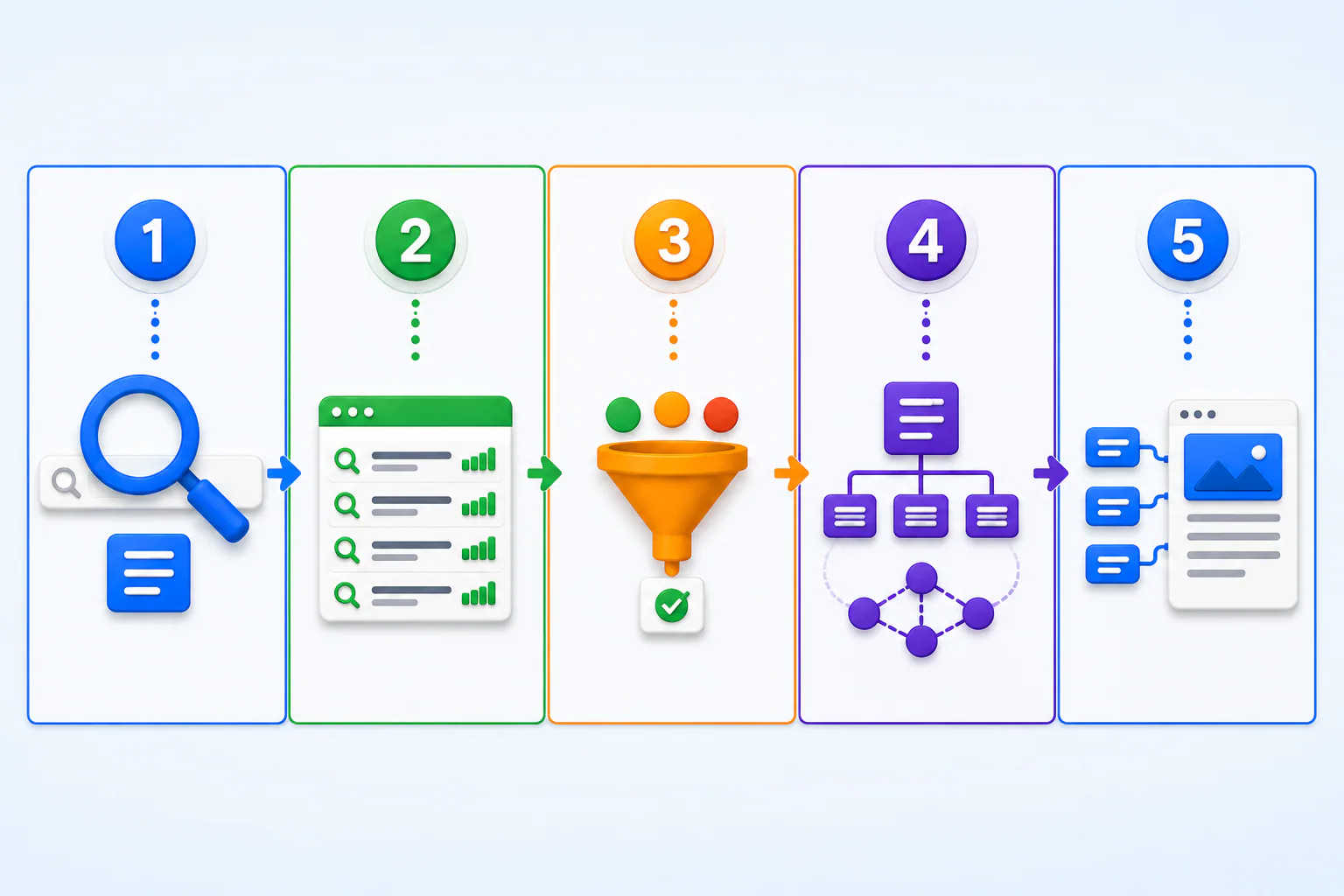
The workflow: Find → Evaluate → Select → Map → Create
Step 1 — Start With Seed Keywords
Seed keywords are broad starting points that describe your business or topic. They are not what you will target — they are what you use to generate the keywords you will actually target.
Examples for a small business focused on digital marketing:
- "digital marketing"
- "SEO"
- "small business marketing"
Step 2 — Expand Into Keyword Ideas
Use tools to generate related keywords, questions, and variations from your seed keywords.
From "SEO" — example expansions:
Each of these is more targetable than "SEO" alone. The longer and more specific the phrase, the lower the competition and the more targeted the intent.
Search volumes and difficulty scores are illustrative examples — verify current figures in your preferred tool before targeting.
Step 3 — Filter the Right Keywords
From your expanded list, select keywords that are:
- Specific enough that one article can fully answer the query
- Problem-focused rather than topic-focused
- Searchable — there is measurable demand, not just theoretical interest
Eliminate keywords that are too broad, too competitive for your current domain authority, or vague enough that you cannot determine what the user actually wants.
Step 4 — Group Keywords Into Topics
Keywords should not be treated in isolation. Group related keywords into topic clusters — one pillar article covering the broad topic, supported by cluster articles targeting specific sub-topics.
Example:
The cluster articles support the pillar through internal links. This helps search engines understand your subject depth and content relationships over time.
Each keyword gets one focused piece of content. One article. One primary keyword. A handful of related secondary keywords that appear naturally in the text.
Trying to rank one article for ten unrelated keywords dilutes the focus and reduces the chance of ranking well for any of them.
Practical Examples
Bad vs good keyword — broad vs specific
The broad keyword gets more searches but you will not rank for it. The specific keywords get fewer searches but you can actually reach the people searching.
Bad vs Good Keyword — Intent Matching
"SEO tips" — informational, mixed intent, high competition. Best content type: list post, general guide.
"hire SEO agency for small business" — transactional, clear buying intent, lower competition. Best content type: comparison page, service page.
Same broad topic. Different intent. Completely different content and conversion strategy.
Seed to Long-Tail — How to Go Deeper
Seed: "SEO" ↓ First expansion: "SEO for small businesses" ↓ Long-tail: "SEO for small business beginners" ↓ Specific long-tail: "how to do SEO for a small business website in 2026"
Each step narrows competition and sharpens intent. The specific long-tail keyword at the bottom of that chain is what a new site should target first.
Tools for Keyword Research
Tools validate keyword opportunities, estimate competition, and identify content gaps. They inform judgment — they do not replace it.
Free Tools — Start Here

Google Keyword Planner
Free with a Google Ads account. Shows search volume ranges and competition level. The data is oriented toward paid advertising but useful for identifying demand.

Google Search Console
Free. Shows which keywords your existing pages already rank for, what position they hold, and how many clicks they generate. Essential for optimizing content you have already published.

AnswerThePublic
Limited free tier. Visualizes the questions people ask around any topic. Useful for finding informational keywords and FAQ content opportunities.

Google Search itself
Free. Type a seed keyword and check the autocomplete suggestions, People Also Ask questions, and Related Searches at the bottom of the results page. These are real queries people type, served by Google directly.
Paid tools — when you are ready to invest

Ahrefs
Starts at $129/month. The most accurate keyword difficulty scores and the best backlink data. The standard tool for serious SEO work.

SEMrush
Starts at $117.33/month. The broadest platform — covers keyword research, site auditing, rank tracking, and competitor analysis in one place.

Ubersuggest
Starts at $12/month. A more affordable option for beginners that covers the core keyword research workflow without the depth of Ahrefs or SEMrush.
Pricing verified May 2026. Check each platform for current rates.
Recommended starter approach: Google Keyword Planner + Google Search Console + Google Search autocomplete. Add a paid tool when you have consistent publishing volume and need more precise competition data.
Common Mistakes Beginners Make
Targeting high-competition keywords from the start
A new site targeting "digital marketing" will not rank on page one for years, if ever. Start with long-tail, low-difficulty keywords and build authority progressively.
Ignoring search intent
Writing an informational article for a transactional keyword, or a sales page for an informational keyword, produces content Google will not rank well because it does not match what the user wants. Check the top-ranking pages for any keyword before writing — they show you what Google believes the intent is.
Creating content without keyword research
Publishing articles on topics with no search demand produces content that will never get organic traffic regardless of quality. Check search volume first.
Targeting multiple unrelated keywords in one article
One article ranks best when it has one clear primary keyword. Trying to cover three unrelated topics in a single article confuses both the reader and the search engine.
Treating tools as strategy
Tools show data. Data does not make decisions. A keyword with high search volume and low difficulty is still a bad target if it does not attract the type of visitor your business actually needs.
Frequently Asked Questions About Keyword Research
What is the difference between keyword research and competitor analysis?
Keyword research identifies what people search for. Competitor analysis identifies what your competitors rank for. The overlap — keywords your competitors rank for that you do not — is your content gap. Both are part of the same SEO workflow but serve different purposes.
How often should I update my keyword strategy?
Review your keyword strategy every three to six months. Search volumes shift, new topics emerge, and your domain authority grows — which means keywords that were too competitive six months ago may now be achievable. Check Google Search Console monthly for keywords your existing pages already rank for but have not fully optimized around.
Can I do keyword research for free?
Yes. Google Keyword Planner, Google Search Console, AnswerThePublic's free tier, and Google's autocomplete and related search features give you enough data to build a solid beginner keyword strategy without spending anything. Paid tools add precision and speed — they are not required to start.
What is keyword cannibalization?
Keyword cannibalization happens when two or more pages on your site target the same keyword. Instead of one strong page ranking, you have two weaker pages competing against each other — and Google has to choose which one to show. Avoid it by mapping each keyword to a single page and ensuring no two articles target the same primary keyword.
How do I know if a keyword is worth targeting?
A keyword is worth targeting if it has measurable search volume, a difficulty score your current domain authority can compete with, clear and specific intent, and direct relevance to what your business offers. If it fails any of these four criteria, move to the next keyword on your list.
Conclusion
Keyword research is not complicated — but it requires structure. Most beginners struggle because they target the wrong keywords, skip research entirely, or focus on volume instead of intent.
The businesses that grow organically are the ones that choose keywords they can realistically rank for, create content focused on those keywords, and build topical authority consistently over time.
Start with one seed keyword. Expand it into a list. Filter for low difficulty and clear intent. Map it to a single piece of content. Publish. Then repeat.
Ready to connect this into a complete system? This article links directly to the digital marketing for small businesses guide, where keyword research fits into a broader content and SEO strategy.
Primary Sources
- Ahrefs. 96.55% of Content Gets No Traffic From Google — New Research for 2023. January 2024. ahrefs.com/blog/search-traffic-study
- Ahrefs. Keyword research tools and keyword difficulty methodology. ahrefs.com
- Google. Google Search Console. search.google.com/search-console
- Google. Keyword Planner. ads.google.com/home/tools/keyword-planner

About the Author
Maan C. is a Filipino writer, blogger, and self-described frustrated journalist who finally found her voice through writing. She holds a degree in psychology, a diploma in Special Education, and spent eight years in the classroom — teaching English as a Second Language to Korean students and handling preschool classes before stepping away to raise her family. After a decade as a full-time mother, she re-entered the workforce as a company-trained SEO specialist and virtual assistant, rebuilding her career from scratch before pivoting to full-time blogging. She writes about everything that genuinely interests her — technology, AI, education, careers, freelancing, travel, finance, real estate, and more — drawing from lived experience, serious research, and a lifelong habit of wanting to understand how things actually work. She describes AI as the tool that finally let her write the way she always wanted to: freely, clearly, and without holding back. Read more of her work at pixelscoop.com.
In this article, Maan writes from her background as a company-trained SEO specialist and her ongoing work as a full-time AI-assisted content creator.