
Upwork vs Fiverr: Which Freelance Platform Is Better for Beginners?
Maan C.
May 21, 2026
14 min read



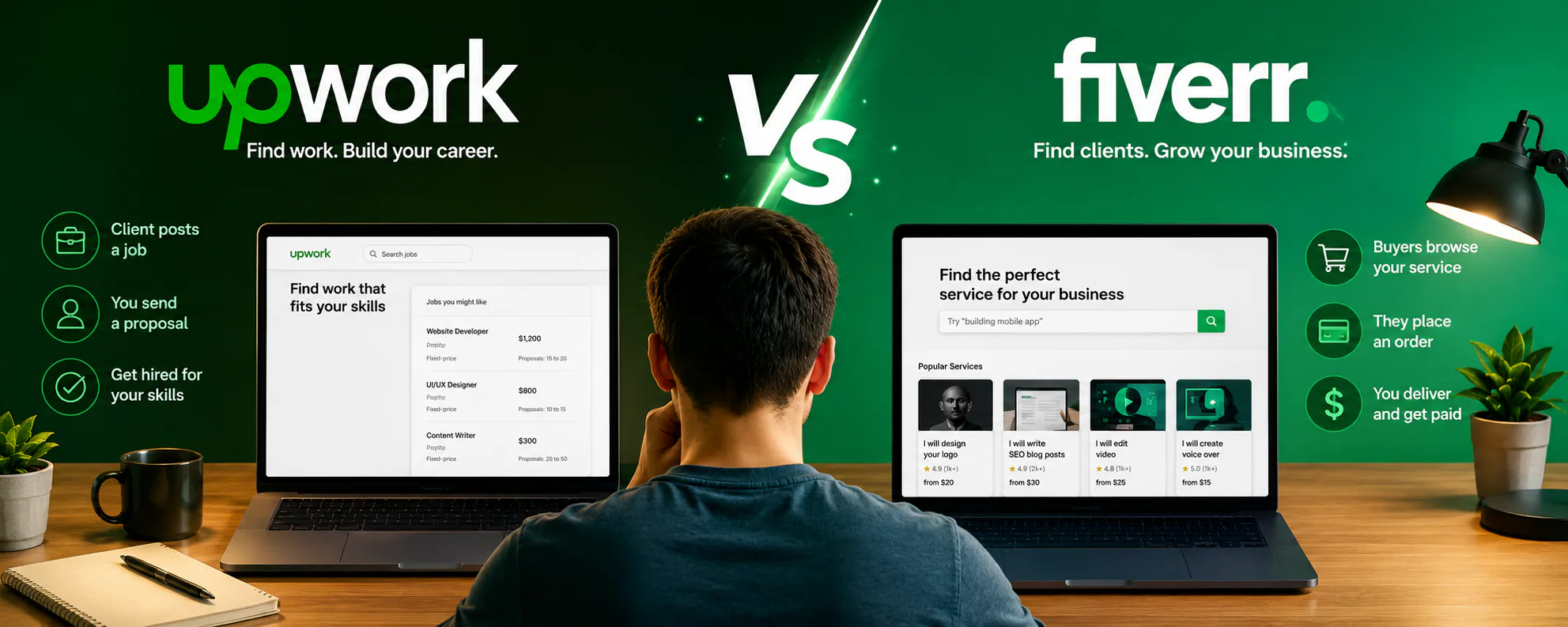
If you are new to freelancing, choosing between Upwork and Fiverr can feel like a significant early decision — and to some extent, it is. Both platforms connect freelancers with paying clients. Both are globally recognized. But they operate on fundamentally different models, attract different types of buyers, and reward different approaches to finding work.
The data reflects how different they actually are. Upwork had 796,000 active clients generating over $4 billion in annual client spend in 2025, while Fiverr had approximately 3.5 million annual active buyers spending an average of $342 each per year. Fiverr has more buyers. Upwork's buyers spend dramatically more per engagement. That single contrast explains most of the strategic difference between the two platforms. Bestjobsearchapps
This guide breaks down both platforms from a beginner perspective: how they work, what they actually cost, how competitive each is, and which one is more likely to be the right fit for the type of work you offer.
Upwork suits beginners who offer flexible professional services and are willing to compete through proposals — it has fewer clients but those clients spend significantly more per project. Fiverr suits beginners with clearly packaged, repeatable services who prefer marketplace discovery over active pitching — but visibility is not automatic and early traction depends heavily on how well the gig is positioned. Upwork's fee is approximately 10% under the current structure; Fiverr's flat 20% cuts deeper and compounds faster on lower-priced work. Neither platform removes the need for strong positioning — they just apply competitive pressure in different places.
Who This Guide Is For
- Beginners deciding where to start their freelance presence
- Freelancers who have tried one platform without traction and are considering the other
- Anyone confused by conflicting advice about which platform is "easier"
- Career returners choosing between platforms for the first time
Quick Answer: Upwork vs Fiverr
Choose Upwork if you offer flexible professional services and are comfortable competing through proposals. Choose Fiverr if you offer clearly packaged, repeatable services and prefer marketplace discovery.
For most beginners offering broad service categories — writing, virtual assistance, admin support, consulting, development, design — Upwork offers stronger structural alignment because the platform is built around custom, project-based work. For beginners offering productized creative services — logo packages, short-form video editing, resume writing, voiceover work — Fiverr's listing-based structure often fits more naturally.
If you are genuinely unsure, Upwork is the safer first recommendation for wider service compatibility. But platform fit matters more than platform popularity.
What Upwork and Fiverr Actually Are
Both platforms connect freelancers with clients. The business models are different, and that difference determines which one is a better fit for how you want to work.
What Is Upwork?
Upwork is a proposal-based marketplace. Clients post projects, freelancers submit proposals, and clients hire from the applicant pool. The flow is: client posts a project → freelancers apply → client reviews and hires. Freelancers actively pursue opportunities rather than waiting to be discovered.
Common service categories include content writing, copywriting, virtual assistance, design, web development, SEO, customer support, consulting, bookkeeping, research, and technical services. Upwork supports a broad range of freelance business models, particularly those involving custom scope and ongoing client relationships.
Submitting proposals on Upwork requires Connects — the platform's proposal currency. Basic accounts receive 10 free Connects per month, with additional Connects available at $0.15 each. Most job applications cost between 2 and 6 Connects depending on the project size.
What Is Fiverr?
Fiverr works differently. Freelancers create service listings (gigs) that buyers browse and purchase directly. The flow is: freelancer creates a listing → buyer discovers it → buyer places an order → work begins. Rather than pitching individual opportunities, Fiverr relies on offer visibility and marketplace discovery.
Fiverr works especially well for repeatable, clearly packaged services: logo design, social media graphics, short-form video editing, blog writing packages, resume writing, voiceover work, presentation design. The structure is easier to understand conceptually — but early visibility is far from guaranteed.
Upwork vs Fiverr: Key Differences
Upwork: Pros, Cons, and Beginner Reality

Upwork Advantages
Clients are actively hiring with larger budgets.
32% of 20
26 Upwork contracts paid $1,000 or more per project, and 145,000 clients spend over $5,000 per year on the platform. The client base skews toward larger, more complex engagements compared to Fiverr's transactional model. Gigradar
Broad service compatibility.
If your service doesn't fit neatly into a simple packaged offer — consulting, custom writing, operations support, development, research — Upwork's proposal-based model handles it better than Fiverr's listing structure.
Better for customized and longer-term work.
Because projects often involve conversation and evolving scope, Upwork supports ongoing client relationships more naturally. That's attractive for freelancers who prefer continuity over constant new-client prospecting.
Payout reliability is high.
Upwork reports 97%+ contract payout success, which is a meaningful trust signal for beginners worried about non-payment. Bestjobsearchapps
Upwork Limitations
Competition is real and visible.
The average Upwork job receives between 20 and 50 proposals, with win rates for individual contracts as low as 1 in 20 — and premium client postings regularly attract 100 or more applicants. As a beginner with no Job Success Score and no completed contracts, you are starting at a structural disadvantage. Getmany
Connects cost money.
Basic accounts get 10 free Connects per month. Most applications require 2–6 Connects each. Active proposal submission will require purchasing additional Connects at $0.15 each — a real cost for beginners who are applying frequently without guaranteed wins.
Active effort is non-negotiable.
Creating a profile and waiting produces almost no results on Upwork. The platform rewards consistent, targeted proposal activity. Beginners who expect passive lead generation will be disappointed.
Fiverr: Pros, Cons, and Beginner Reality
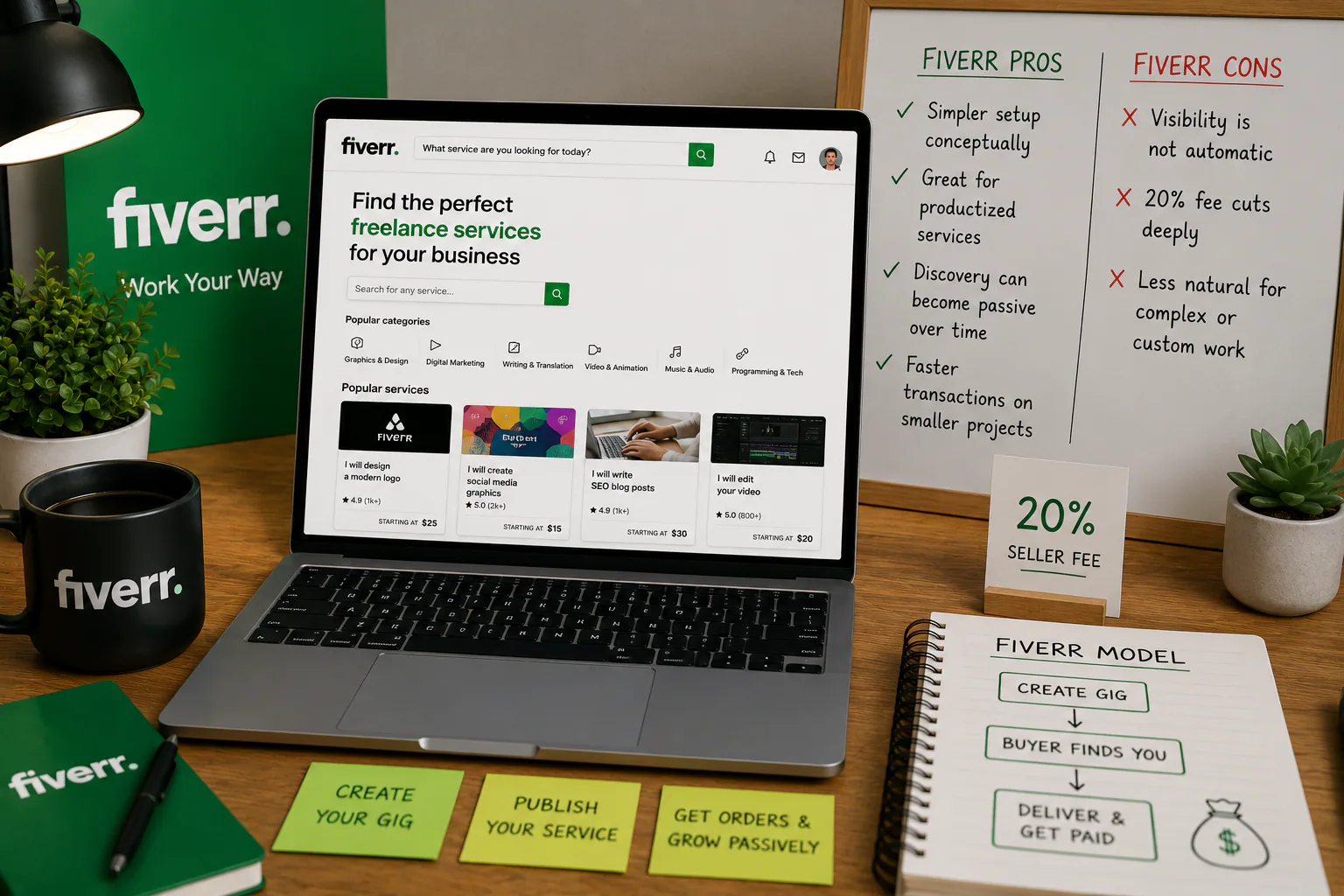
Fiverr Advantages
Simpler setup conceptually.
The basic model — create a service listing, publish it, let buyers find it — is easier to understand than Upwork's proposal workflow. For beginners, this structural simplicity is genuinely appealing.
Better fit for productized services.
If your offer can be cleanly defined — three logo concepts delivered in three days, five social media graphics, a one-page resume — Fiverr's listing model aligns naturally with that structure.
Discovery can become passive over time.
Unlike Upwork, you are not required to pitch every opportunity manually. A well-positioned listing that gains momentum can generate inbound inquiries without constant active effort. Getting to that point takes time and early traction, but the potential is real.
Faster transactions on smaller projects.
For quick-turn, clearly scoped deliverables, Fiverr's streamlined buying process is efficient for both sides.
Fiverr Limitations
Visibility is not automatic.
Publishing a gig does not mean clients will find it. Fiverr's active buyer count has been declining since a peak of 4.28 million — down to approximately 3.5 million as of Q1 2025. Competition for listing visibility is intense, and new sellers without reviews start with minimal discoverability. Jobbers
The 20% fee cuts deeply, especially on lower-priced work.
A $50 gig nets $40 after Fiverr's fee. A $100 gig nets $80. On the lower-priced end of the marketplace where many beginners start, the fee compression is significant. Buyers also pay a 5.5% fee plus $3.50 on orders under $200, which affects how clients perceive total cost.
Less natural for complex or custom work.
If your service requires extensive discussion, scope clarification, or evolving deliverables, Fiverr's listing-based structure can feel limiting.
Platform Fees: The Real Numbers
Fee comparison matters — but beginners often make the mistake of choosing a platform based on fees before choosing based on fit. A lower fee on the wrong platform produces nothing.
Upwork Fees
Upwork charges a variable 0–15% service fee from freelancers, with Business Plus clients paying 8–10% on payments to freelancers on the client side. Under the fee structure updated in 2025, the old tiered 20%/10%/5% system was replaced with a variable rate that typically lands around 10% for most contracts. Upwork
To net $20/hour on Upwork after a 10% fee, you need to quote approximately $22.22/hour.
Fiverr Fees
Fiverr charges sellers a consistent 20% commission on all earnings. Buyers pay a minimum 5.5% fee on each transaction, with an additional $3.50 assessed when a buyer spends less than $200. Upwork
To net $20/hour on Fiverr after a 20% fee, you need to quote $25/hour.
The Practical Gap
On a $500 project, Upwork retains $50 (at 10%), leaving $450. Fiverr retains $100 (at 20%), leaving $400. Scale that to $5,000 per month, and the annual fee difference between the two platforms at comparable earnings is approximately $6,000. For beginners working at lower price points, Fiverr's flat 20% becomes increasingly painful as project sizes stay small.
Competition: What Beginners Are Actually Walking Into

Upwork Competition
Competition on Upwork happens at the proposal level. You compete for client attention, shortlist placement, and trust — before any conversation begins. On average, each Upwork project receives 20 to 50 proposals, and success rates for winning a contract can be as low as 1 in 20. As a beginner with no Job Success Score, no completed projects, and no reviews, your proposals are competing against established freelancers who have all three. Getmany
The practical beginner strategy: target smaller projects ($100–$500) to build reviews and Job Success Score, avoid postings with 100+ proposals, personalize every proposal extensively, and submit within the first few hours of a job being posted — proposals submitted within 60 minutes of posting get meaningfully higher reply rates.
Fiverr Competition
Competition on Fiverr happens at the listing level. You compete for search visibility, click-through appeal, and buyer trust — before any interaction occurs. A beginner with no reviews, no sales history, and no visibility signals starts with very little algorithmic support. Many beginners underestimate how long it takes to build initial traction on Fiverr.
Which Competition Is Harder?
Upwork competition is more visible — silence after proposals stings. Fiverr competition can feel deceptively passive until visibility becomes the bottleneck. Neither is low-competition. They apply pressure in different places.
Earning Potential: What the Data Says
The average Upwork freelancer earns $30–$50 per hour for professional services, with top freelancers exceeding $100 per hour on complex projects. Fiverr's average sits lower at $15–$25 per hour, reflecting the platform's orientation toward lower-priced, transactional work — though strong Fiverr sellers who build visibility and offer well-structured upsells can perform well above that average. Bestjobsearchapps
Upwork's earning potential is stronger when projects are larger, services are customized, specialization improves pricing power, and long-term client relationships develop. Fiverr's earning potential is stronger when offers are productized clearly, delivery is repeatable, visibility builds over time, and upsell structures are effective.
Neither platform guarantees income. Earning potential depends on service type, positioning, competition handling, communication, and consistency — not platform branding.
Who Should Choose Upwork?
Upwork is often the stronger fit if you offer:
- Writing, copywriting, or content strategy
- Virtual assistance or admin support
- Consulting or advisory services
- Web development or technical implementation
- Operations or project coordination
- Research or SEO services
And you prefer: applying directly to opportunities, custom project conversations, service flexibility, and relationship-based client work.
Who Should Choose Fiverr?
Fiverr tends to make more sense if you offer:
- Graphic design or logo packages
- Video editing or motion graphics
- Voiceover work
- Resume or presentation writing
- Productized social media content
- Repeatable creative deliverables
And you prefer: structured packages, faster transactions, standardized deliverables, and marketplace discovery over proposal writing.
Freelance Platform Decision Checklist

Before choosing a platform, answer these:
- Can my service be packaged into a fixed deliverable? If yes, Fiverr is viable. If no, Upwork is the better fit.
- Am I comfortable writing personalized proposals repeatedly? If no, Fiverr removes that requirement.
- Does my pricing absorb a 20% fee without hurting sustainability? If not, Upwork's lower fee matters.
- Do I need custom scope conversations before quoting? If yes, Upwork handles that better structurally.
- Am I willing to build slowly without guaranteed early visibility? Both platforms require this — set expectations accordingly.
Frequently Asked Questions
Is Upwork better than Fiverr for beginners?
Often yes for broad-service freelancers — but not universally. Upwork's 796,000 active clients generate over $4 billion in annual spend, creating genuine demand for professional services. Fiverr's larger buyer base spends less per transaction on average, which suits packaged creative services better. The better platform depends on your service model, not a universal rule. Bestjobsearchapps
Can beginners actually make money on Fiverr?
Yes — but not by publishing a gig and waiting. Early visibility on Fiverr is limited for new sellers without reviews or sales history, and Fiverr's active buyer base has been declining from a peak of 4.28 million, settling at approximately 3.5 million as of Q1 2025. Traction requires strong offer positioning, clear packaging, and some patience before the platform's algorithm starts surfacing your listing organically. Jobbers
Is Upwork too competitive for beginners?
Competitive, but not unusable. The average job receives 20 to 50 proposals and win rates can be as low as 1 in 20 — but targeting smaller, less-contested projects and submitting high-quality personalized proposals early in a job's posting window significantly improves outcomes. Most beginners who struggle on Upwork fail at positioning and proposal quality, not because the platform is inherently inaccessible. Getmany
Which platform has better-paying clients?
Upwork. 32% of Upwork contracts paid $1,000 or more per project in 2026, and 145,000 clients spend over $5,000 per year on the platform. Fiverr's average buyer spends approximately $342 per year total. The difference in client budget expectations between the two platforms is significant and shapes everything from project scope to long-term earning potential. Gigradar
Can I use both platforms at the same time?
Yes, and many successful freelancers do. A common strategy is maintaining an Upwork presence for larger custom projects while using Fiverr for productized lower-touch deliverables. The risk is dividing your early attention before you've built traction on either — most beginners benefit from focusing on one platform first and expanding once they have a working system.
How do platform fees affect what I should charge?
Directly. To net $20/hour after Upwork's ~10% fee, quote approximately $22.22/hour. To net the same $20/hour after Fiverr's 20% fee, you need to quote $25/hour. Factor this into your pricing before you list — not after you notice the difference in your first payout. Bestjobsearchapps
Conclusion
Upwork and Fiverr both work. The question is which one works for what you're actually offering.
Upwork is the stronger fit for broader professional services — writing, consulting, development, virtual assistance, and anything that benefits from custom scope conversations and longer client relationships. Fiverr is the stronger fit for productized, repeatable creative services where clear packaging and marketplace discovery are assets.
Neither platform removes the hard work of building credibility from zero. They just apply competitive pressure in different places. Choose based on how you want to sell your services — then give whichever platform you choose enough time and iteration to produce real results.
Primary Sources
- Upwork. In-Depth Comparison: Upwork vs. Fiverr 2026. May 2026. upwork.com/resources/upwork-vs-fiverr
- Upwork SEC Filings / Backlinko. Upwork active clients and annual spend data 2025. Via bestjobsearchapps.com
- Fiverr Investor Relations. Annual active buyer count Q1 2025. Via jobbers.io/fiverr-vs-upwork-vs-freelancer-vs-jobbers-complete-comparison-2026
- GigRadar. Upwork vs Fiverr Fee Math + Free Calculator 2026. April 2026. gigradar.io/blog/upwork-vs-fiverr-compare
- Getmany. Upwork Bidding Mastery 2025: Proposals, Win Rates, and Competition. December 2025. getmany.com/blog/upwork-bidding-mastery-2025
- Jobbers.io Research Team. Fiverr vs Upwork vs Freelancer vs Jobbers: Complete Comparison 2026. March 2026. jobbers.io

About the Author
Maan C. is a Filipino writer, blogger, and self-described frustrated journalist who finally found her voice through writing. She holds a degree in psychology, a diploma in Special Education, and spent eight years in the classroom — teaching ESL to Korean students and handling preschool classes before stepping away to raise her family. After a decade as a full-time mother, she re-entered the workforce as a company-trained SEO specialist and virtual assistant, rebuilding her career from scratch before pivoting to full-time blogging. She writes about technology, AI, education, careers, freelancing, travel, finance, real estate, and more. Read more at pixelscoop.com.
In this article, Maan draws from her own experience navigating a 10-year career gap, re-entering the workforce in a completely new field, and rebuilding income from the ground up. Read more at pixelscoop.com.